
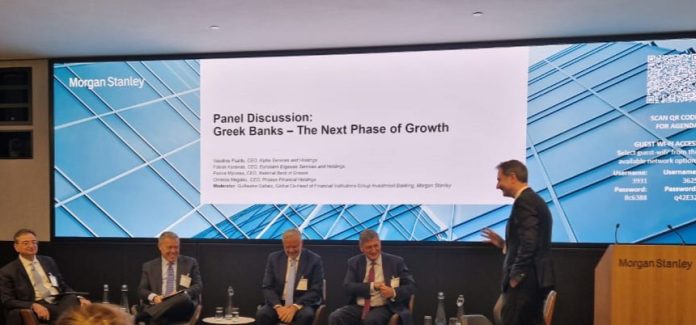
At the panel discussion on the topic: “Greek Banks: The next phase of growth” within the framework of the 4th HELEX-Morgan Stanley Investment Conference, the four systemic CEOs discussed the country’s credit system in comparison to European levels and developed the prospects for 2026.
Revenue sources from now on
According to banking sources who attended the conference, Piraeus Bank CEO Christos Megalou pointed out that net credit growth is at 8%, making it the second highest in Europe after Ireland, reflecting investments directed towards the development of businesses and SMEs. However, as he pointed out, not many steps are being taken in retail credit expansion. “The growth of mortgage loans is frugal, but in 2026 it is possible to see some growth in retail banking,” the Piraeus CEO said, among other things. Referring to net interest margins (NIM), he stressed that they are at good levels compared to Europe, and stability is expected if interest rates remain at current levels, in line with expectations, while with regard to net interest income (NII), it may be higher in 2026, Megalou estimated, thus creating prospects for another year of profitable and sustainable results.
In turn, Eurobank’s CEO Fokion Karavias focused on his position on the diversification of Greek banks’ revenues and mainly on commission income. As he pointed out, at the beginning of 2025, Eurobank had presented the drivers of its banking growth as (1) the growth of loans, (2) the growth of commission income and (3) the Hellenic Bank of Cyprus. Regarding commission income, he said that “indeed, in recent years we have seen strong performance, with double-digit growth in all categories”. However, he stressed that it is important to “focus more on asset management and insurance due to their strategic importance.
“First, the penetration of asset management and insurance is lower than in the EU, so it can grow above the nominal GDP growth. Second, banks are working with insurance companies”. For example, Eurobank has collaborated with CNP and Eurolife, Piraeus with Ethniki Insurance. “There are synergies, but also a large margin for growth. It is expected that commissions from asset management and insurance will reach 30% of total commissions,” estimated the CEO of Eurobank, while at the same time, he predicted that the overall increase in commissions will be double-digit in the near future and in the long term, commissions will reach 30% of total revenues.
Acquisitions and mergers
On the other hand, Vasilis Psaltis, CEO of Alpha Bank, in his statement referred to the strict capital framework under which Greek banks thrive.


“We operate under a strict capital allocation framework. The first pillar is organic growth and is a priority. The second pillar is shareholder remuneration, which started low, is growing, and is set to deliver a 50% dividend this year and will continue to grow sustainably. And the third pillar is the use of excess capital, i.e. the acceleration of the strategy through mergers and acquisitions,” he pointed out. Besides, capital reserves are now at the same level as the EU.
Christos Megalou, in turn, said that a balance must be maintained and perhaps this is the “best possible moment”, given that banks have capital and liquidity, allocate capital, are able to carry out mergers and acquisitions and create capital reserves.
Technology as a driver of growth
In a context of evolving digital transformation, technology could not be missing from the discussion, which is changing the way banks, especially Greek banks, operate, a sector in which all banks have made particular efforts.
This was also pointed out by Pavlos Mylonas in his statement on the panel “Greek Banks: The next phase of growth”. Highlighting the benefits that this change has brought, he mentioned the following: 1) the reduction of costs by moving from branches to the digital environment, as NBG has saved 150 million annually, 2) the improvement of the customer experience, as 98% of transactions are now carried out digitally, 3) assistance in sales, as half a million sales were made through digital channels last year and banking via video call is gaining ground, and finally, 4) the development of new products, as the new systems allow the development of sophisticated products.
Για να εμφανίζονται περισσότερα άρθρα της Ναυτεμπορικής στις αναζητήσεις σας εύκολα και γρήγορα, πρέπει να προσθέσετε το site στις προτιμώμενες πηγές σας. Μπορείτε να το κάνετε πηγαίνοντας εδώ.