
The success rate that, under current conditions, could “unlock” an exploration drilling in Greece is estimated at 15%–20%, given that the lack of recent drilling data lowers the acceptable risk threshold compared with mature markets such as Norway or the United Kingdom.
“An exploration well is typically undertaken with a 15%-20% chance of success,” sources with in-depth knowledge of the sector noted, clarifying that this figure may vary by region and over time. Under current conditions, and given that the last offshore drilling in Greece was carried out in 1982 in Katakolo, a success rate in the 15%–20% range is considered sufficient for an exploration well.
In more mature markets, however, such as Norway, the United Kingdom or the United States, success rates can rise to as high as 35%, as the greater volume of drilling data provides a much clearer understanding of geological structures and, consequently, of the level of risk considered acceptable.
In Greece, similarly, the risk profile may be revised upwards or downwards depending on the progress of the hydrocarbons exploration programme.
Drilling rig charter

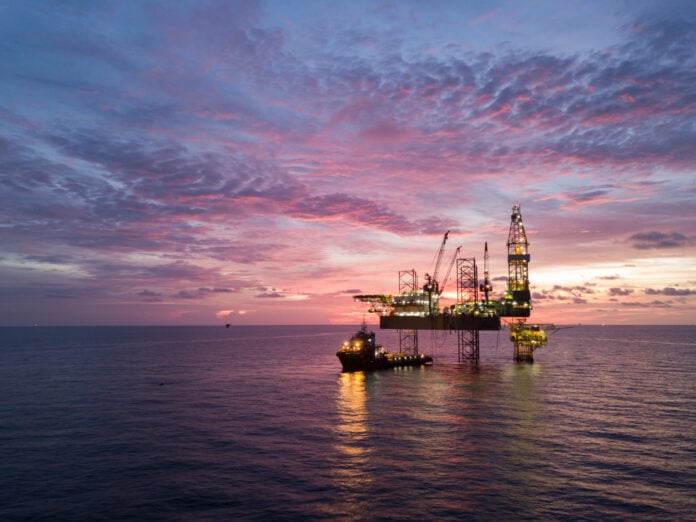
For the time being, according to statements made by Energean Chief Executive Officer Mathios Rigas at the signing ceremony for the charter agreement of the Stena DrillMAX drilling rig, the estimated success rate for the planned February 2027 exploration well in the northwestern Ionian Sea, at the “Asopos 1” target, is placed at 16%, with available data indicating potential resources of up to approximately 270 billion cubic metres of natural gas or around 5 billion barrels of oil.
It is noted that sources with direct knowledge of Greece’s hydrocarbons programme underlined that a potential discovery in Block 2 would not allow for safe conclusions to be drawn regarding the southern Ionian Sea. As they explained, additional exploration drilling would be required to confirm the existence or absence of a petroleum system across different parts of the country.
At present, alongside the northern Ionian, attention is also focused on Block 10 in the Kyparissia Gulf, where Chevron recently formalised its entry in a deal that had been developing over the past four years. The US company acquires a 70% stake and acts as operator, while Helleniq Energy retains the remaining 30%.
It is recalled that both 2D and 3D seismic surveys have been completed in the block, with the consortium granted a 15-month extension to the second exploration phase to allow Chevron and Helleniq Energy to jointly analyse the data, also taking into account the adjacent smaller Block A2, where direct 3D seismic surveys are planned. The proximity of the two areas—Block 10 and A2—is expected to potentially lead to coordination of operations across the wider region, in order to determine whether the consortium will proceed to the third phase, which includes exploratory drilling.
In any case, sources with deep knowledge of the processes underlined the fluidity and uncertainty that characterise the upstream sector, noting that beyond any estimates, it is impossible to know with certainty whether natural gas or oil will be discovered, in what quantities, or in what form. The performance of an investment, they explained, can vary even within a distance of 50 kilometres.
Eastern Mediterranean gains momentum
The recent momentum in Greece’s hydrocarbons programme is part of the broader rise of the Eastern and Central Mediterranean on the radar of major international energy companies, driven by a series of developments over the past 15 years: from the discovery of the Leviathan field in Israel and Zohr in Egypt to the war in Ukraine, which prompted companies previously operating in Russia to seek alternative regions such as the Mediterranean, closer to European markets.
Against this backdrop, major players such as Chevron have a presence in five offshore blocks in Greece. The US group already has a presence or has concluded agreements with a number of countries in the region, including Egypt, Israel, Cyprus, Turkey, Libya and Algeria.
Για να εμφανίζονται περισσότερα άρθρα της Ναυτεμπορικής στις αναζητήσεις σας εύκολα και γρήγορα, πρέπει να προσθέσετε το site στις προτιμώμενες πηγές σας. Μπορείτε να το κάνετε πηγαίνοντας εδώ.