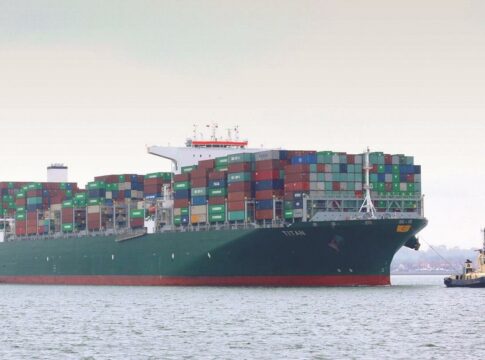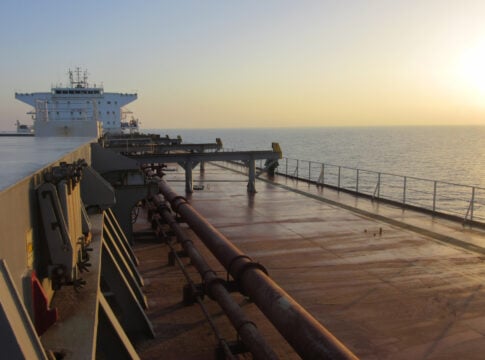

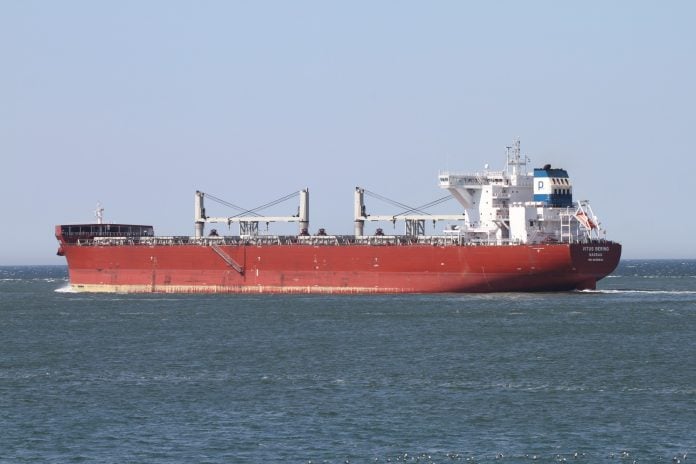
The strong recovery in the dry bulk freight market has brought Capesize vessels back into focus, with shipowners increasing their exposure to both newbuildings and secondhand tonnage.
Αs earnings have reached some of the highest levels in recent years and Greek owners have increased new orders, the market indicates that large bulk carriers have regained momentum. A recent analysis by Allied shows that the Capesize segment is no longer driven solely by spot market dynamics, but by longer-term strategic positioning.
Despite higher voyage costs driven by more expensive fuel and geopolitical uncertainty, Capesize vessels (averaging around 150,000 dwt) have remained among the most profitable segments in recent years.
The Baltic Capesize 5TC index averaged around 22,950 dollars per day in the first quarter, approximately 77% higher year-on-year, while average earnings in the first half reached around 29,400 dollars per day, nearly double compared with the same period last year. More recent data also show Capesize rates holding at elevated levels, with average earnings around 33,700 dollars per day despite a recent correction.
Cargo flows
The improvement has been driven primarily by cargo demand. Strong Chinese demand for iron ore, combined with steady exports from Australia and Brazil, has kept the main Brazil–China and Australia–China trade routes stable throughout the first half of the year.


Guinea has also participated through the major Simandou project, which has begun to significantly increase shipment volumes.
Monthly exports rose from an average of around 0.6 million tonnes in the first quarter to 1.3 million tonnes in April and a record 2.2 million tonnes in May.
Although these volumes remain modest relative to the project’s long-term potential, their impact in tonne-mile terms is significantly larger, as the route to China is roughly three times longer than shipments from Australia.
Investment activity
The improvement in freight rates and expectations of stronger long-haul trade routes have triggered a renewed wave of investment in Capesize vessels.
Between March and early June, 27 Capesize/VLOC newbuilding orders were recorded, rising to 31 units including options, alongside 15 secondhand transactions.
Ordering activity peaked in May, when 14 new orders were placed in a single month, accounting for more than half of the total during the period.
Greek shipowners played a prominent role in the newbuilding market, securing capacity for the coming years and signalling positioning ahead of the next upcycle.
Notably, the report referred to new orders such as those by Tsakos Group for two 180,000 dwt Capesize vessels at Hengli Heavy Industries, scheduled for delivery in 2028.
However, Allied also cautions that the Capesize revival raises a key question: whether the growing orderbook will be matched by sufficient cargo demand.
If the Simandou ramp-up remains gradual, Chinese steel demand does not accelerate, and iron ore and bauxite flows fail to expand as expected, there is a risk that part of the new tonnage could be delivered ahead of adequate cargo growth.
Για να εμφανίζονται περισσότερα άρθρα της Ναυτεμπορικής στις αναζητήσεις σας εύκολα και γρήγορα, πρέπει να προσθέσετε το site στις προτιμώμενες πηγές σας. Μπορείτε να το κάνετε πηγαίνοντας εδώ.