
Greece is seeking to move beyond its role as a user of space technologies and become a country that designs, develops and manufactures satellite systems.
Backed by the new HELLAS-SPACE 2.0 national programme, with a budget of around 350 million euros, and a planned investment by Finnish satellite operator ICEYE to build a satellite manufacturing facility in Greece, the government aims to create a new high-tech industry with an international outlook, hundreds of skilled jobs and strong export potential.
Factory with capacity to produce up to 150 satellites annually
A central role in the initiative is expected to be played by ICEYE, which has announced plans to establish a large-scale satellite manufacturing facility in Greece.
The investment envisages a production site of more than 5,000 square metres, capacity to manufacture up to 150 satellites per year and the creation of more than 250 highly skilled jobs.
If completed as planned, the facility would become ICEYE’s largest production base globally and one of Europe’s most significant satellite manufacturing sites.


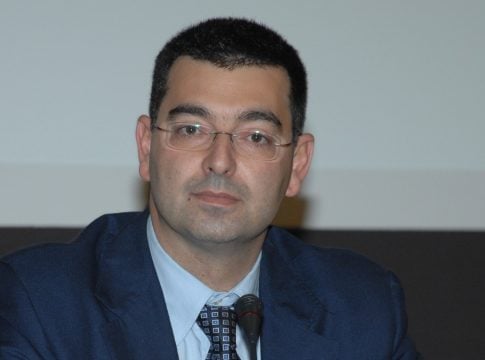
“We want to establish in Greece a major hub for production, research, development and innovation serving the global space industry,” Vasilis Chaloulakos, head of ICEYE Greece, told the Athens-Macedonian News Agency (ANA-MPA).
The 350-million-euro programme
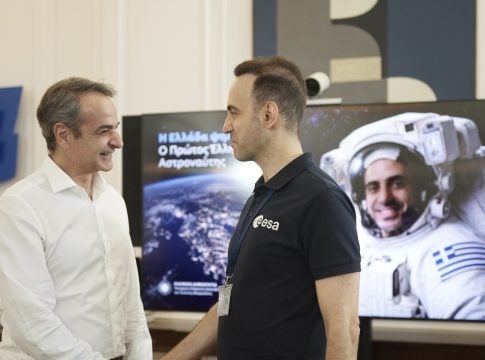
The investment forms part of Greece’s new national space strategy, presented by the Ministry of Digital Governance and Artificial Intelligence in the presence of Prime Minister Kyriakos Mitsotakis under the “Greece in Orbit” initiative.
Mitsotakis said that only a few years ago, few would have believed that Greece would now have satellites in orbit, a growing ecosystem of space companies and secured funding of 350 million euros from the Recovery and Resilience Facility over the next four years.
HELLAS-SPACE 2.0 represents the second phase of Greece’s space policy and aims to expand the use of space technologies in critical sectors including disaster prevention, civil protection, maritime surveillance, precision agriculture, border security and secure communications.
From infrastructure to national capabilities
Digital Governance and Artificial Intelligence Minister Dimitris Papastergiou said the country is entering a new phase of development.
“Over the past few years we built important infrastructure through the first national microsatellite programme. We put Greece into orbit. Today we are taking the next major step. We are moving from infrastructure development to building real, sustainable national capabilities,” he said.
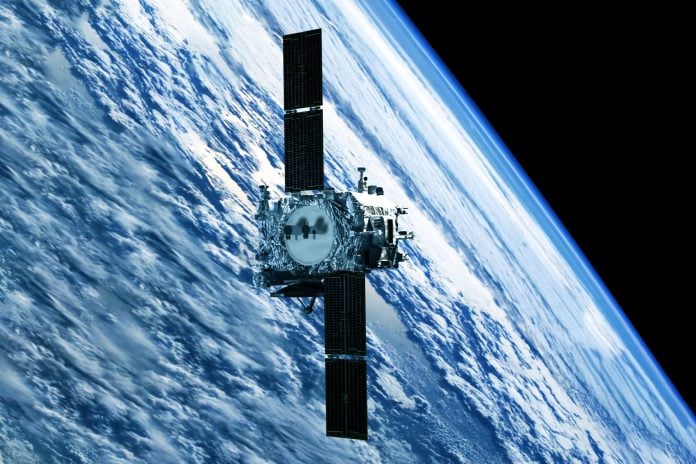
ICEYE’s planned facility fits squarely within that strategy. The company is already participating in Greece’s microsatellite programme through the development and launch of the country’s first Synthetic Aperture Radar (SAR) satellites.
Building a complete space industry ecosystem
The planned facility will extend well beyond satellite assembly operations.
It will include production lines, testing infrastructure, research laboratories and the development of critical subsystems, creating a broader aerospace technology ecosystem around it.
“This is a fully integrated industrial facility with the capacity to produce hundreds of satellites annually. It will also host research activities focused on next-generation space technologies that will be developed in Greece for the company’s global satellite fleet, creating significant added value for the Greek economy,” Chaloulakos said.
New jobs and reversing brain drain
The government aims to ensure that the value created by the emerging space economy remains in Greece by building a strong industrial base and creating new opportunities for highly skilled professionals.
“There is also a second equally important goal: to help the Greek space industry take off. We want to see Greek companies become champions in Europe while exporting technology and products globally,” Papastergiou said.
The investment is expected to create jobs for satellite systems engineers, electronics and radar specialists, data scientists, artificial intelligence researchers, as well as highly skilled production and quality-control personnel.
At the same time, ICEYE plans to deepen cooperation with Greek universities, research institutions and start-ups.
“Our objective is to strengthen synergies with Greek universities, start-ups and more mature Greek companies in order to expand the national footprint of this effort. We also aim to increase our workforce to several hundred employees, contributing to the return of talented Greeks currently working abroad,” Chaloulakos said.
Για να εμφανίζονται περισσότερα άρθρα της Ναυτεμπορικής στις αναζητήσεις σας εύκολα και γρήγορα, πρέπει να προσθέσετε το site στις προτιμώμενες πηγές σας. Μπορείτε να το κάνετε πηγαίνοντας εδώ.