

Greece is emerging as a pivotal player in Europe’s energy security at a moment of profound global disruption, according to Geoffrey Pyatt, who warns that the war in the Gulf has triggered the most severe shock to international energy supplies since the 1973 oil embargo.
Speaking to Naftemporiki ahead of the 11th Delphi Economic Forum in April, Pyatt — now Senior Managing Director for Energy and Critical Minerals at McLarty Associates — described a “historic opportunity” for Greece to reposition itself at the center of Europe’s evolving energy map.
A strategic opportunity anchored by Chevron
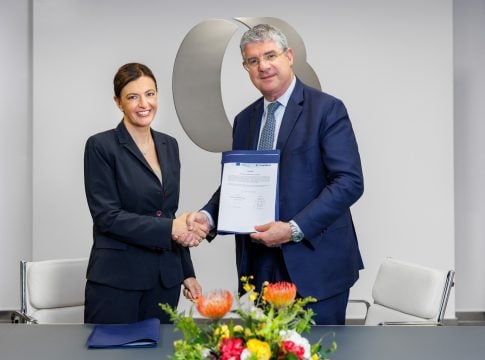
At the heart of this shift is the agreement between Greece and Chevron, which Pyatt framed as far more than a commercial deal.
“The Greece-Chevron agreement represents a major potential opportunity for further expanding the country’s role as a major European energy hub.”
Chevron’s footprint across the Eastern Mediterranean — including Egypt, Israel, Jordan and Cyprus, with potential expansion into Libya — reinforces Greece’s strategic importance.
“Aside from their industry leading technical capacities offshore, they also bring to Greece a strong record across the region and a demonstrated commitment to building productive, cooperative relationships across borders.”


Greece as a gateway for U.S. LNG
The surge in U.S. liquefied natural gas exports is another defining element of the new energy landscape — and one that places Greece at its center.
“The growing volumes of U.S. LNG available in international markets, and the expanding US-Greece cooperation to bring those molecules to Europe, represents a major strategic opportunity both from an American commercial standpoint and for Greece’s role in supporting European energy security.”
As Europe moves to fully phase out Russian oil and gas by 2027, demand for alternative supplies is intensifying. The U.S. already accounts for roughly 58% of Europe’s LNG imports, while the EU absorbs about 65% of U.S. exports.
“The role of Greece as a major energy transit country was one of the most important legacies of my time in Athens, and I am glad to see this working being sustained and deepened.”
The Vertical Corridor reshapes energy flows
A key pillar of this transformation is the so-called Vertical Corridor — a network linking Greece with Southeastern and Central Europe.
“The Vertical Corridor is becoming a new path for American LNG to supply central and eastern Europe up to Moldova and Ukraine.”
The initiative gained momentum in November 2025, when Bulgaria, Greece, Moldova, Romania, Ukraine and the United States agreed to advance the project.
Infrastructure developments are already demonstrating its impact. The Alexandroupolis FSRU has created a new southern entry point for LNG into Europe, while the Trans-Balkan Pipeline — now operating in reverse flow — connects Greece to Ukraine and beyond.
Recent transactions underscore the system’s growing relevance: Ukraine’s DTEK received its first U.S. LNG cargo via Revithoussa in 2024, while gas has also been transported from Ukrainian storage to Poland through the same network.
“This demonstrates the Vertical Corridor’s full end-to-end functionality and its energy security relevance for the wider Central Europe region.”
War-driven shock and a new energy paradigm
The broader geopolitical context is accelerating these developments.
“The ongoing war in the Gulf is the most severe shock to international energy supplies since the 1973 Arab Oil Embargo.”
Pyatt argues that the crisis marks a structural turning point.
“Until a few weeks ago, markets took Gulf resources for granted. That will not be the case going forward.”
The shock is expected to reinforce the global focus on energy security and diversification, strengthening Greece’s long-term strategy.
“Over the long term, this will reinforce the ‘all of the above’ energy approach that Greece has pursued, including a strong focus on renewable sources like wind, solar, and grid scale batteries.”
A long-term strategic partnership
Energy, Pyatt emphasizes, will remain at the core of U.S.-Greece relations.
“As in past years, energy will continue to be a priority area of cooperation in the relationship between the US and Greece, and the Vertical Corridor will remain a core element of the partnership.”
In a world of rising geopolitical tension and energy uncertainty, Greece is no longer just a regional player — but an increasingly critical node in Europe’s energy architecture.
Για να εμφανίζονται περισσότερα άρθρα της Ναυτεμπορικής στις αναζητήσεις σας εύκολα και γρήγορα, πρέπει να προσθέσετε το site στις προτιμώμενες πηγές σας. Μπορείτε να το κάνετε πηγαίνοντας εδώ.