
The Chinese shipbuilding industry is entering a phase of total strategic dominance in the global shipbuilding market, expanding and upgrading its power with the participation of the private sector, now focusing on technologically complex, energy-efficient and “green” ships.
The latest data confirm that Chinese shipyards control the majority of new orders worldwide, leaving behind traditional shipbuilding powers and shaping a new, highly competitive landscape for international shipping.
Indicative of the new reality is the milestone announced by Hudong-Zhonghua Shipbuilding Group, a subsidiary of China State Shipbuilding Corporation, on the occasion of the recent delivery of Ocean Oasis, an LNG carrier with a capacity of 174,000 cubic meters.
According to the company, its production capacity in LNG ships doubled during the 14th Five-Year Plan period (2021-2025), confirming the acceleration taking place in the Chinese shipbuilding ecosystem.
Since the beginning of the year, Hudong-Zhonghua has completed the construction of 13 large LNG carriers, of which 11 have already been delivered.


The Ocean Oasis is a prime example of the new operational maturity: measuring 295 meters long and 45 meters wide, it was built in just 16 months – the shortest time ever recorded for a ship of this type.
The result was that the naming and delivery of the ship took place three and a half months ahead of schedule.
This picture stands in stark contrast to the past of the Chinese shipbuilding industry.
The country’s first domestic LNG carrier, the Dapeng Sun, was delivered in April 2008 after 40 months of construction, while the entire project took almost ten years from conception to completion.
The comparison is revealing: in less than two decades, China has not only closed the technological gap, but is now shaping the terms of the game in the shipbuilding industry worldwide.
Private shipbuilding
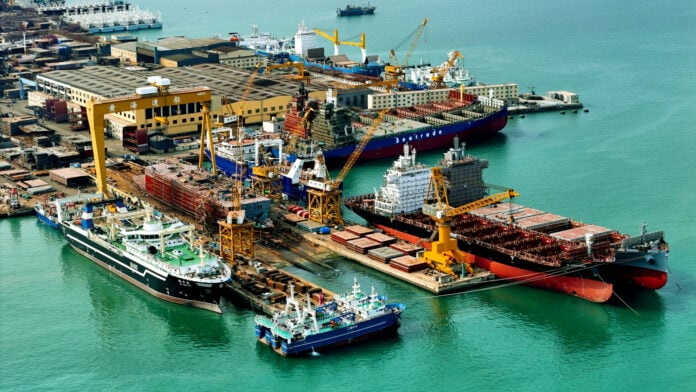
At the same time, the opening of a new private shipyard in Rongcheng, Shandong, confirms that the Chinese shipbuilding industry has entered a new phase of qualitative and technological upgrading, with the clear aim of further strengthening its position in the global market.
The project is being developed by Shandong Dadong Shipbuilding, with the support of the private group Xinfa Holdings and an investment of 3.9 billion yuan, emphasizing not only newbuildings but also repairs, conversions and dual-fuel ships, sectors that are strengthened by the energy transition.
This strategy is part of the broader planning of Shandong province, which is already one of the leading shipbuilding centers in China, while the reactivation of old shipyards by private groups, such as the Chishan Group, highlights the renewed investment potential of the sector.
Specifically, Chishan Group acquired the inactive Baibuting Shipbuilding in Rongcheng, Shandong Province, a shipyard with a history dating back to 1953, which had drastically reduced its activity after the global financial crisis.
After the acquisition, the shipyard was renamed Shandong Fuerdun Shipbuilding and put back into operation, marking its return to production.
However, it should be noted that the dynamic development of the private shipbuilding market was opened by the shipbuilding unit of Hengli Heavy Industry, whose new yard in Dalian is the second largest in the world.
The new “Future Factory”, which was completed in just 153 days on Changxing Island, extends over more than two million square meters and, when fully operational, employs up to 50,000 workers, with the capacity to build VLCCs, ultra-large containerships, LNG carriers and offshore engineering units.
The rise of Hengli, following the acquisition of STX (Dalian) facilities, is accompanied by developments that show that China is not simply increasing its capacity, but is consolidating its supremacy in more complex, technological and “green” shipbuilding projects, intensifying international competition.
At the top
In 2024, China ranked first in new orders for bulk carriers, tankers and containerships, with the sole exception of LNG carriers, where even South Korea’s traditional dominance is now being challenged.
87.4% of ships built in China were for export, with the value of exports reaching 43.38 billion dollars.
The China State Shipbuilding Corporation group remains at the top, with 23% of global newbuilding orders, followed by large private shipyards such as New Times Shipbuilding and Yangzijiang Shipbuilding Group.
The picture that emerges is clear: China is not only increasing its capacity, but is also consolidating its hegemony in more complex, technological and “green” shipbuilding projects, shaping a new, particularly demanding environment for international shipping.
According to Clarksons data, in 2024, shipbuilders worldwide received 2,412 new orders, totaling 65.81 million compensated gross tonnage (CGT) – a 34% increase on 2023 and the highest level since 2007 (94 million CGT).
China accounts for 70% of new orders
The figures in the shipbuilding industry confirm the Chinese dominance.
According to the BRS Group analysis, Chinese shipyards secured 70% of new orders worldwide in 2024, in CGT terms, while increasing their production capacity by about 200 ships annually.
Of the top ten shipbuilding units in the world, seven are located in China.
The country’s total shipbuilding capacity is estimated to increase by 12%, reaching 47.8 million dwt, while the ratio of unfulfilled orders to annual production capacity reached a historic high of 5.5, with most shipyards fully booked until after 2028.
Για να εμφανίζονται περισσότερα άρθρα της Ναυτεμπορικής στις αναζητήσεις σας εύκολα και γρήγορα, πρέπει να προσθέσετε το site στις προτιμώμενες πηγές σας. Μπορείτε να το κάνετε πηγαίνοντας εδώ.