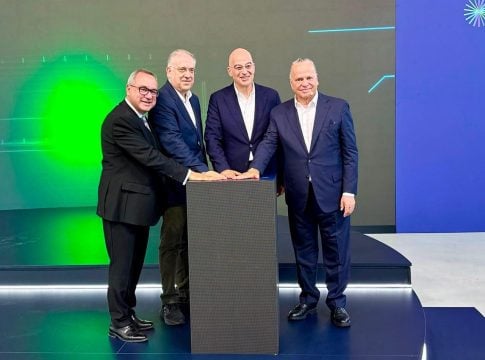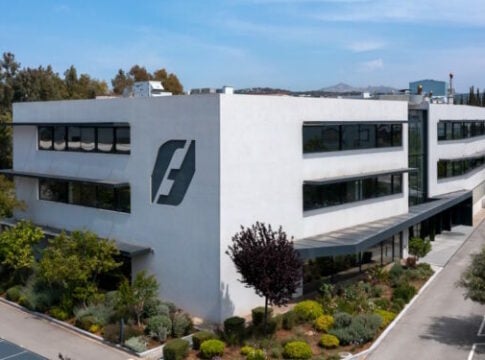

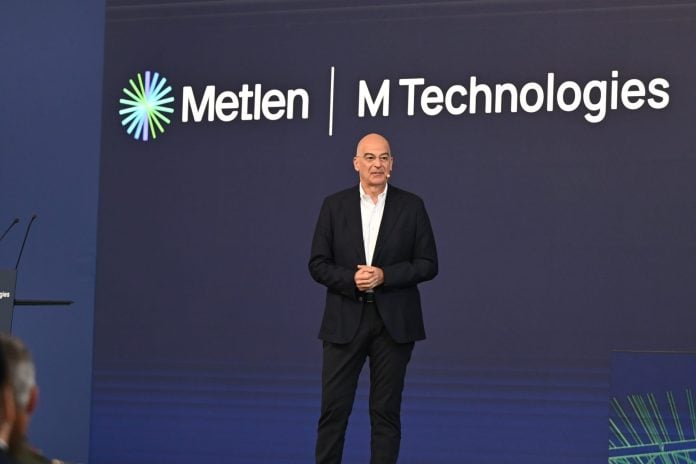
Greek Defence Minister Nikos Dendias, speaking at the inauguration of METLEN’s fourth M Technologies industrial facility at the company’s defence hub in Volos, stressed the need for a far-reaching overhaul of Greece’s defence model, linking national security to innovation, industrial production and economic self-sufficiency.
Recalling long-standing structural weaknesses, Dendias outlined a new defence framework based on cooperation between the state, research institutions and domestic industry.
He noted that Greece had invested more than 270 billion euros in national defence up to 2004, while highlighting the limited economic impact of that spending.
“Greece invested more than 270 billion euros in its national defence up to 2004. Against that enormous investment, the contribution of the defence ecosystem to gross domestic product did not exceed 0.5% two years ago,” he said, arguing that despite substantial expenditure, the country had failed to leverage those investments to build a strong domestic defence industry.
He also referred to Greece’s two major challenges.


“The country faces two major challenges. The first concerns security, as Greece is confronted with a real threat, including a declared casus belli from a neighbouring country. The second is the long-standing deficit in the balance of external payments, which contributed decisively to the economic crisis,” he said.
Need for a new defence model
Dendias said Greece must address security concerns and economic resilience simultaneously.
“We are therefore called upon to use the money that Greek taxpayers contribute, often at significant sacrifice, for the country’s defence in a way that addresses both of these challenges,” he said.
According to Dendias, the solution lies in a different and more innovative approach to defence and industrial production.
A key element of the reform is a change in the philosophy of the armed forces, he said, explaining that they should define operational problems and seek solutions from the broader defence ecosystem.
“Not products, solutions,” he said.
Dendias also highlighted the rapid pace of technological change and the increasingly short life cycle of modern defence systems.
“A product that has value today may be obsolete in eight to ten months,” he said, citing the evolution of drones from simple remotely operated systems to artificial intelligence-enabled platforms.
Innovation and acceptance of risk
The minister also stressed the need for the state to allow experimentation and even tolerate failure.
“We must allow for the risk of failure. And we must subsidise that risk of failure,” he said.
He referred to Greece’s long-term defence procurement planning framework, known as the Multi-Year Defence Procurement Programme, stressing that predictability is essential for both industry and investors.
Concluding his remarks, Dendias reiterated the importance of mandatory domestic industrial participation in defence procurements at a level of around 25%.
“For every system that is not produced by a Greek company, 25% should correspond to investment in the country,” he said.
He also underlined the importance of access to source codes and technological know-how, arguing that Greece must avoid remaining technologically dependent on foreign suppliers.
Για να εμφανίζονται περισσότερα άρθρα της Ναυτεμπορικής στις αναζητήσεις σας εύκολα και γρήγορα, πρέπει να προσθέσετε το site στις προτιμώμενες πηγές σας. Μπορείτε να το κάνετε πηγαίνοντας εδώ.