
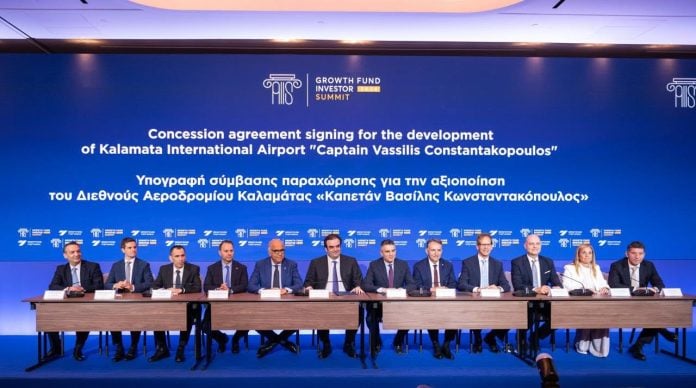
More than 1 billion euros in investments over the next three years will be mobilised through the Hellenic Innovation and Infrastructure Fund (HIIF), Deputy Prime Minister Kostis Hatzidakis said at the Growthfund Investor Summit 2026.
According to Hatzidakis, the fund is already fully operational, with its first investment in digital infrastructure expected shortly. He said the objective is to mobilise more than 1 billion euros in capital by 2029, while projects financed by the fund could ultimately reach a value of 20 billion euros.
Economy and Finance Minister Kyriakos Pierrakakis announced the rebranding of Growthfund as the National Development Fund. He said the move reflects a transition towards a more active role in supporting economic growth, with a focus on sectors including digital infrastructure, data centres, artificial intelligence, semiconductors, energy and logistics.
Pierrakakis said Growthfund currently manages assets worth 12.3 billion euros, with 23 subsidiaries and holdings, operations across 11 strategic sectors of the economy and more than 25,000 employees in its portfolio companies.
Growthfund Chief Executive Yiannis Papachristou highlighted the Invest10 initiative, which aims to identify and develop the next generation of strategic investment opportunities in Greece, seeking to convert current investor interest into a new wave of productive investments.

Working alongside consultancy McKinsey, the Ministry of National Economy and Finance and Growthfund are mapping sectors where Greece enjoys competitive advantages in order to attract investment into industries capable of generating significant multiplier effects for economic growth.
Deputy Chief Executive Panagiotis Stampoulidis said investments worth 3.5 billion euros had been implemented through the organisation over the past three years, including projects in ports, transport and healthcare infrastructure.
As an example, he cited the port of Alexandroupolis, where dredging works and its connection to the Egnatia motorway have recently been completed.
BC Partners Europe Chairman Nikos Stathopoulos said international investors are showing increasing interest in both Europe and Greece.
He noted that European markets currently appear more attractive than the United States and said BC Partners has more than 3.5 billion euros available for investment.
Commenting on artificial intelligence, Stathopoulos said the technology is likely to be a major source of disruption across multiple sectors of the economy.
As a result, the potential impact of AI on a company’s business model is now a key consideration in evaluating investment opportunities. He added that geopolitical risks are also playing an increasingly important role in investment decisions, while AI is simultaneously creating new opportunities for investors.
AI driving infrastructure demand
OTE Group Chairman and Chief Executive Kostas Nebis highlighted the growing demands that artificial intelligence applications place on networks and digital infrastructure.
He said the expansion of AI services is significantly increasing requirements for connectivity and computing power, revealing that more than 25% of the group’s processes already use AI tools. That figure is expected to rise to 40% by the end of the year.
Nebis also referred to OTE’s investments in data centre infrastructure and GPU-as-a-Service offerings for businesses, as well as the company’s target of extending its fibre-optic network to 3.5 million households and businesses by 2030.
Public Power Corporation (PPC) Chairman and Chief Executive George Stassis focused on the energy transition and the need for new digital infrastructure, arguing that rising demand driven by digital transformation requires large-scale investment.
He referred to a planned 1 GW data centre project in Kozani, currently undergoing the licensing process, describing it as the largest facility of its kind in the wider region. He said the area is gradually transforming from a lignite-based energy hub into a centre for technology and modern energy infrastructure.
Innovation ecosystem
The Hellenic Development Bank of Investments (HDBI) also featured prominently in discussions on Greece’s innovation ecosystem.
Chief Executive Antigoni Lyberopoulou said investment schemes supported by HDBI currently provide total capital of 2.2 billion euros, while investments have already been made in 42 funds.
Similarly, Antonis Tzortzakakis, Chief Executive of 5G Ventures (Phaistos), said public funding had mobilised investments worth 1.3 billion euros, attracting a further 1.7 billion in private capital.
In the infrastructure sector, Hellenic Innovation & Infrastructure Fund (HIIF) Chief Executive Stelios Fragkos argued that the main challenge is no longer a lack of available capital, but rather the limited number of mature projects ready for financing and persistent delays in permitting procedures.
In biotechnology, Alex Tzoukas, managing partner at Kos Biotechnology Partners, announced plans to establish a computer science centre in Greece. He said the country’s talent pool remains a key factor in attracting investment and noted that artificial intelligence is already helping reduce the time required to develop new medicines.
Για να εμφανίζονται περισσότερα άρθρα της Ναυτεμπορικής στις αναζητήσεις σας εύκολα και γρήγορα, πρέπει να προσθέσετε το site στις προτιμώμενες πηγές σας. Μπορείτε να το κάνετε πηγαίνοντας εδώ.