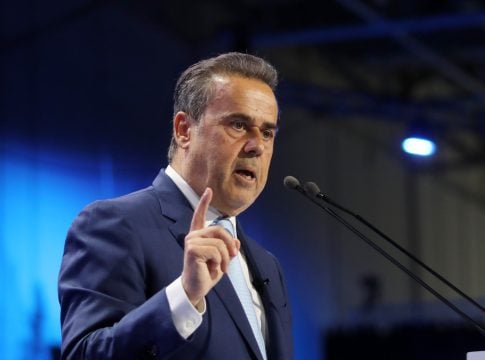

“Greece and Italy will continue to work together to defend the competitiveness of European shipping and ports, while supporting a fair and realistic energy transition for the maritime industry that does not place additional burdens on the average European household.”
That was the message delivered by Maritime Affairs and Insular Policy Minister Vassilis Kikilias during a visit to Rome, where he participated in the international “Shaping the Future of Shipping Summit 2026 – Forging Partnerships for Resilience” and held meetings with Italian government officials and senior representatives of the global maritime industry.
Speaking at the ministerial panel of the International Chamber of Shipping Summit, alongside Cyprus Deputy Shipping Minister Marina Hadjimanolis, Malta’s Minister for Sustainable Mobility Chris Bonett and Panama Canal Administrator Ricaurte Vásquez, Kikilias highlighted the strategic importance of European shipping and ports to the bloc’s competitiveness.
He noted that around 90% of global trade is transported by sea, with direct implications for households, businesses and economic activity across Europe.
Kikilias said Europe should leverage its shipping industry and port infrastructure as a strategic asset, particularly at a time when, as highlighted in the Draghi report, the European economy faces mounting pressure to close the competitiveness gap with the United States and China.


“For the next period, major investments involving shipyards, energy, shipping, marinas and the cruise industry — investments that will generate growth and employment opportunities — will be linked to the sea,” he said.
The minister stressed the importance of closer coordination among southern European countries, arguing that the Greek and Italian shipping sectors represent key pillars of the European economy and maintain strong links to both society and the real economy.
Addressing the European Union’s Emissions Trading System (ETS) and the transition to alternative fuels, Kikilias called for realistic and implementable policies that would not undermine the competitiveness of European shipping or divert activity to non-EU ports in the Mediterranean.
“We want ports that remain attractive hubs for global shipping, rather than policies that push vessels towards the southern Mediterranean and non-European ports,” he said.
Kikilias warned that excessive regulatory and financial burdens on the sector would ultimately be passed on to the broader economy.
“We are not seeking to commit political or economic suicide,” he said, adding that EU policymakers should take into account the impact that unrealistic policies could have on competitiveness, energy costs, transport and consumer prices.
Meeting with Salvini
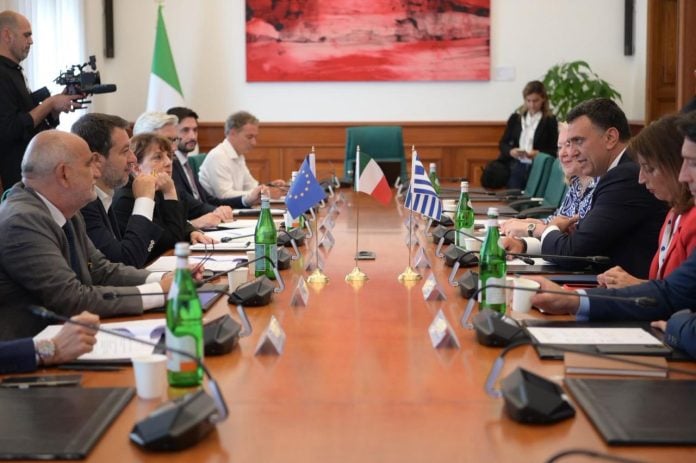
On the sidelines of the conference, Kikilias met Italian Deputy Prime Minister and Minister of Infrastructure and Transport Matteo Salvini.
The meeting, attended by Greece’s ambassador to Italy Eleni Sourani, focused on the common challenges facing the Greek and Italian shipping industries, which together account for a significant share of European maritime activity.
The two sides agreed to continue coordinating efforts to safeguard the competitiveness of European ports and support a fair and realistic energy transition for the shipping industry without imposing additional costs on European households.
They also stressed that pragmatic policymaking could help unlock the full competitive advantages of European shipping, supporting maritime employment and broader economic prosperity.
The discussions also highlighted the need to deepen cooperation between Greece and Italy, strengthen supply-chain resilience and continue promoting common positions on issues shaping the future of European shipping and Mediterranean ports.
Για να εμφανίζονται περισσότερα άρθρα της Ναυτεμπορικής στις αναζητήσεις σας εύκολα και γρήγορα, πρέπει να προσθέσετε το site στις προτιμώμενες πηγές σας. Μπορείτε να το κάνετε πηγαίνοντας εδώ.