
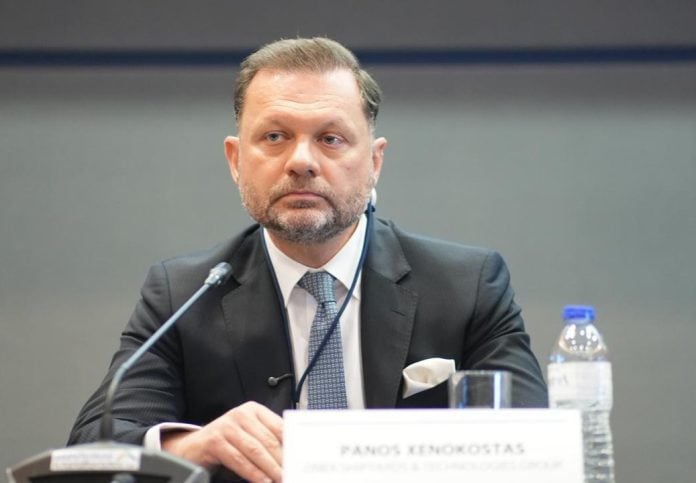
The need for a new transatlantic strategy aimed at rebuilding Western shipbuilding capacity, advancing breakthrough technologies through Project NEXUS, and utilizing revenues generated by the European Union’s Emissions Trading System (ETS) to finance new shipbuilding infrastructure was highlighted by Panos Xenokostas, Chairman and CEO of ONEX and President of the Hellenic Shipyards Association (HSA), during his keynote address at the 5th Trading in US Waters Seminar held as part of Posidonia 2026.
Xenokostas argued that shipbuilding should be recognized as critical economic and national security infrastructure, warning that the current concentration of global ship production in a limited number of shipbuilding hubs creates significant geopolitical risks for Western economies and global supply chains.
He noted that the construction cost differential for a Very Large Crude Carrier (VLCC) between Western shipyards and state-subsidized Asian competitors amounts to approximately 125 million dollars. However, when amortized over the vessel’s 25-year lifespan, the actual impact on end consumers is only 0.0036 per litre of fuel—equivalent to approximately 18 cents per vehicle refuelling. Since freight markets cannot independently absorb this cost premium, the HSA advocates a Demand-Side Leveling Mechanism rather than protectionist tariffs that could trigger trade disputes. Such a mechanism would offset the capital expenditure (CapEx) premium directly at the shipyard gate.
A New Decade-Long Transatlantic Shipbuilding Pact
A central pillar of Xenokostas’ address was the proposal for a new strategic framework for cooperation between Europe and the United States, extending over at least a ten-year horizon.
“As a matter of urgency, we need a new Transatlantic Shipbuilding Pact,” he stated. “A coordinated ten-year strategy with one unwavering objective: Europe and the United States must collectively regain one-third, or 33%, of global shipbuilding output.”

He emphasized that recovering this market share is not merely an industrial objective but a prerequisite for safeguarding economic sovereignty, energy security, and the resilience of Western supply chains. Referring to the consequences of excessive production concentration, he warned that “this is no longer free trade; it is strategic dependency,” stressing that Western economies must restore a meaningful portion of their shipbuilding capabilities.
Xenokostas also welcomed the United States’ shift toward a policy of maritime self-reliance under President Donald Trump and called on Europe to align with this strategic direction.
Within this framework, the Hellenic Shipyards Association is advocating the immediate establishment of a European Ship Preference Framework, a legislative initiative that would introduce strategic, environmental, and quality criteria for vessels operating within Western economic zones, thereby encouraging domestic shipbuilding activity.
Project NEXUS: The Technological Vanguard of the Next Shipbuilding Era
Presenting ONEX’s vision for the future of shipbuilding, Xenokostas identified Project NEXUS as the technological cornerstone of this strategy.
“The spearhead of this strategy is Project NEXUS,” he stated. The initiative combines the development of commercial vessels powered by next-generation Small Modular Reactors (SMRs) with the deployment of advanced digital shipbuilding technologies.
“We must leap directly into the true future of global logistics,” he noted, highlighting the potential of SMR technology to significantly reduce operating costs while providing long-term energy autonomy.
At the same time, he described the transformation of shipyards through artificial intelligence, automation, and digital technologies, emphasizing that “we are transforming our shipyards through Silicon Shipbuilding,” leveraging Generative AI, robotic manufacturing systems, and Digital Twin technologies to enhance productivity, efficiency, and design capabilities.
Recycling ETS Revenues to Finance a Shipbuilding Renaissance
Xenokostas also stressed the importance of redirecting revenues generated through the EU Emissions Trading System (ETS) back into the maritime and shipbuilding sectors.
He argued that, as shipping companies bear substantial carbon-related costs under the ETS, these revenues should be reinvested in infrastructure, innovation, and new industrial capacity. “We demand the immediate recycling of these carbon-related revenues,” he stated, proposing the creation of a dedicated Shipbuilding Recovery and Sovereignty Fund.
As he explained, “Shipowners currently paying significant carbon charges should have complete certainty that their capital is being returned directly, strategically, and transactionally to their own industry.”
Under the proposal, ETS revenues could support the development of new shipbuilding infrastructure, the construction of zero-emission vessels, and the establishment of advanced, high-technology shipyard facilities across Europe and the United States.
Concluding his address, the ONEX Chairman called on governments, policymakers, industry stakeholders, and the global maritime community to support a coordinated transatlantic initiative aimed at restoring balance to the shipbuilding sector and strengthening the long-term resilience of Western economies.
“Let us begin the Shipbuilding Renaissance today, right here at Posidonia,” he concluded.
Για να εμφανίζονται περισσότερα άρθρα της Ναυτεμπορικής στις αναζητήσεις σας εύκολα και γρήγορα, πρέπει να προσθέσετε το site στις προτιμώμενες πηγές σας. Μπορείτε να το κάνετε πηγαίνοντας εδώ.