
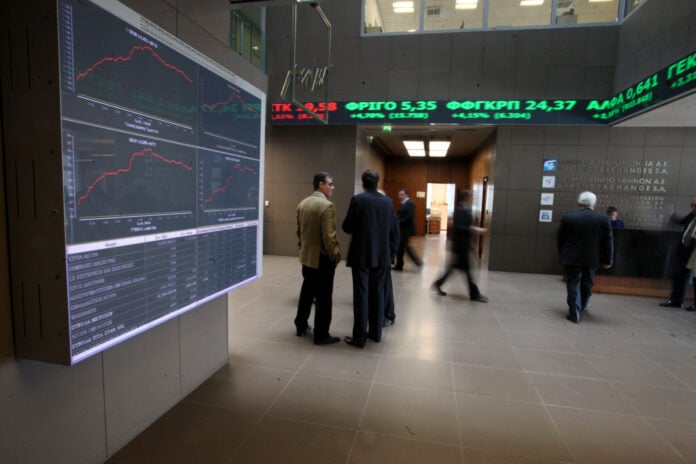
The Athens Stock Exchange remains under pressure as it prepares to enter a third week marked by uncertainty, volatility and nervousness as it is closely tied to the risk of a geopolitical conflict in the Middle East and a further increase in energy costs—which could trigger a new inflationary wave in the economy.
With the end of hostilities still highly unclear, the investment community appears unwilling to take on unnecessary risks. This is something the Greek market is paying a heavy price for, also reflecting the market’s long-standing lack of depth. “The Greek stock market moves in harmonization with international markets, as 70% of transactions are carried out by foreign investors who are liquidating Greek blue chips,” noted Dimitris Tzanas of Kyklos Securities.
Since the outbreak of the war in Iran and the broader escalation across the Persian Gulf region, the General Index has recorded losses of 6.3%, while the corresponding decline in bank stocks has reached 9.7%. As a result, the overall loss is estimated at 9.8 billion euros in market capitalization, while blue chips—which had carried the market during the bull run of previous months—are proving the most vulnerable under current conditions.
Unfortunately, the outlook for the coming days is not expected to differ significantly. As long as there is no clear strategy for ending hostilities, the climate of uncertainty will continue to undermine investor confidence in equities. At present, the baseline scenario—largely priced in by the markets—envisages a conflict lasting roughly four weeks.
But what will happen if the sirens continue to sound for a significantly longer period? Could this have broader repercussions for transport and tourism? How will oil prices react if global supply is further reduced and the Strait of Hormuz remains closed indefinitely? And most importantly: can the economy and listed companies withstand a new wave of inflation alongside rising borrowing costs (higher interest rates)? All this just four years after the cost-of-living crisis of 2022.


The answer to the above questions will largely determine the short- to medium-term scenario for the Athens Stock Exchange. “As the range of possible developments extends from an immediate ceasefire to a new escalation of tension, the priority of large portfolios has shifted more to managing and adapting to different scenarios and less to seeking investment opportunities arising from price corrections,” Beta pointed out, among other things, in its report on the performance of the market.
Για να εμφανίζονται περισσότερα άρθρα της Ναυτεμπορικής στις αναζητήσεις σας εύκολα και γρήγορα, πρέπει να προσθέσετε το site στις προτιμώμενες πηγές σας. Μπορείτε να το κάνετε πηγαίνοντας εδώ.