
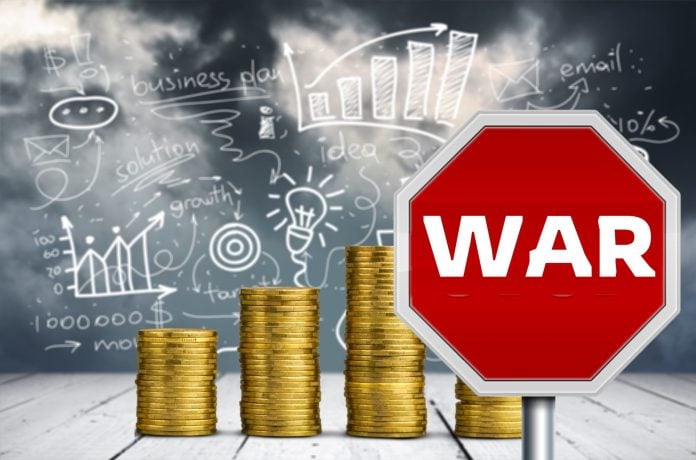
The escalation of the war in the Middle East threatens to trigger a new energy shock with consequences for inflation, growth and businesses across Europe and Greece.
Damage to energy infrastructure in the Persian Gulf, the near-freeze in shipping through the Strait of Hormuz and the risk of disruptions to oil supply are creating new pressures for economies, potentially derailing government plans and the European Central Bank’s policy path.
For Greece, the main vulnerability remains its reliance on imported energy. At the same time, the country also has some important buffers that could help cushion the shock.
The conflict is unfolding at a time when the global economy is still trying to stabilize after the energy crisis triggered by Russia’s invasion of Ukraine in 2022.
One more shock for the global economy
Responding to a question from Naftemporiki, Greg Kiss, Director for Western Europe Sovereigns at Fitch Ratings, described the war as another shock for the global economy, though one that may prove relatively short-lived.


“The war in the Middle East is a new shock for the global economy, and we are already seeing significant damage to energy infrastructure in the Gulf. The shock to energy supply will lead to higher inflation and add pressure to the economy,” he said.
Fitch estimates that the crisis could last less than a month. If the conflict proves short-lived, Greece’s economic growth could remain close to 2%, according to Kiss.
For Greece, membership in the euro area remains a key shield. In addition, the country benefits from very favorable financing conditions, something not all members of the monetary union enjoy.
As Kiss explains, this means Greece would likely be less affected by a potential tightening of monetary policy—with markets currently pricing in up to two ECB rate hikes this year—than other economies.
Pressure on growth and prices
Europe remains particularly sensitive to energy disruptions, fueling concerns that the conflict could halt the recent slowdown in inflation and trigger a new wave of price pressures.
The key risk lies on the energy supply side. Any significant disruption in oil or natural gas flows could push prices higher and reignite inflation.
Samuel Tilleray, Associate Director in Sovereign Ratings at S&P Global, who covers Greece, told Naftemporiki that the scale of the impact will depend largely on the duration and intensity of the conflict.
“The effects of the war in the Middle East will depend on the duration and extent of hostilities,” he said.
“At this early stage there is significant uncertainty about how the conflict will evolve and, consequently, about the magnitude of the impact on Greece. However, across all scenarios we would expect downward pressure on growth and upward pressure on inflation.”
Greece’s relatively high reliance on imports, reflected in its large current account deficit, exposes the country to developments in global energy markets.
At the same time, the government still has fiscal space to provide support if needed—as it did during the 2022 energy shock—without materially undermining the country’s credit profile.
This reflects the core dilemma facing European economies: rising energy prices tend to slow growth while simultaneously fueling inflation.
A different energy shock from 2022
Despite the concerns, some analysts believe the current energy shock differs from the one triggered by Russia’s invasion of Ukraine.
Jason Graffam, Senior Vice President for European Sovereign Ratings at Morningstar DBRS, says the nature of the crisis today is different.
“The most immediate economic concern for European countries following the outbreak of the bombardments in the Middle East is whether the conflict will trigger a new wave of inflation driven by energy prices,” he said.
“We cannot rule out tighter monetary policy if this shock leads to sustained increases in energy prices and another period of high inflation across EU member states.”
However, Graffam notes that the situation differs from 2022, when Europe faced a structural shift away from Russian natural gas.
“At this stage, the current disruption in energy markets appears reversible,” he said.
He added that the European economy, price levels and policy interest rates are now starting from a very different position compared with 2022.
“These factors suggest that the pass-through from energy prices to EU inflation in 2026 is likely to be more limited than in 2022, although this assessment could change depending on the duration and intensity of the conflict.”
The duration of the crisis is key
Yesenn El-Radhi, Senior Vice President at Morningstar DBRS responsible for Greece, also stressed that the duration of the shock will be decisive.
“This is a generalized shock, and we do not expect the disruption in energy prices to place disproportionate pressure on the Greek economy,” he said.
“The size of Greece’s oil import bill relative to GDP is broadly in line with that of most EU countries.”
However, if the energy shock persists and fuels higher inflation, it could weigh on household purchasing power and private consumption, he warned.
Ultimately, the real question for the global economy is not only how long the conflict lasts, but whether the Middle East once again becomes the source of a prolonged cycle of energy instability.
If disruptions in oil and gas supply prove persistent—even after the war ends—Europe could face a new shock just as it is still trying to move beyond the crisis of 2022.
In that scenario, the trajectory of energy prices, interest rates and consumer demand will determine not only the pace of Europe’s economic growth, but also the resilience of countries such as Greece that remain exposed to global energy markets.
Για να εμφανίζονται περισσότερα άρθρα της Ναυτεμπορικής στις αναζητήσεις σας εύκολα και γρήγορα, πρέπει να προσθέσετε το site στις προτιμώμενες πηγές σας. Μπορείτε να το κάνετε πηγαίνοντας εδώ.