
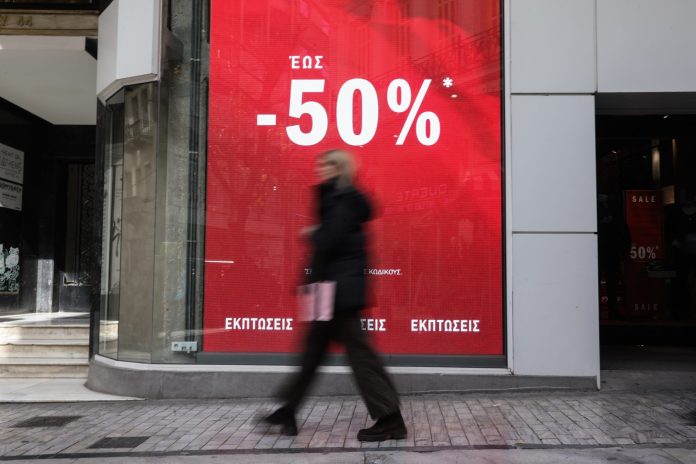
The tight market conditions are reflected in the findings of a major survey conducted by the Institute of the Hellenic Confederation of Commerce and Entrepreneurship, covering this year’s winter sales period and based on a representative sample of retail stores across Greece.
During the winter discount season, one in two businesses recorded lower turnover, while only one in 10 reported higher sales compared with the same period last year — a development that underscores the mounting strain caused by the decline in real sales throughout 2025.
Despite generous price reductions, the sluggish movement is due to the reduced purchasing power of consumers, who are first turning to covering their basic needs, but also to the impact of unfair competition from Asian platforms.
Therefore, pressures on trade, in the strongest sector of the economy in terms of turnover and employment, are maintained in early 2026, widening uncertainty in the midst of a particularly fluid international environment.
Key findings of the 2026 survey
– Half of businesses (50%) in retail recorded worse sales during the winter sales compared to last year, while only 1 in 10 recorded better ones.
– Although after the disappointing performance of 2025, the expectations of merchants remained low, half of businesses (48%) appeared to be slightly to not at all satisfied with sales during the winter sales.
– Disappointment during the sales combined with the strict regulatory framework, forced 2 out of 3 entrepreneurs not to maintain reduced prices and offers after the official end of the discount period.
– Indicative of the tightness in the market but also of the intensity of the effort of merchants to attract consumers is the fact that 2 out of 3 businesses adopted discount rates of more than 30%.
– Sales for 1 in 3 businesses did not change significantly during the discount period. However, the importance of January for sales seems to be limited, a finding repeated for the second consecutive year, and highlights how Christmas gifts (in the private sector) are redirected to meet other needs, mainly inelastic ones.
– Seven in 10 businesses adopted the same discount rates compared to last year, while 1 in 4 even higher.
– Four in 10 businesses are somewhat or not at all satisfied with consumer traffic, a development largely due to low disposable income for purchases.
– Four in 10 businesses made discounts on all store merchandise. However, a significant share (22%) of entrepreneurs adopted discounts on specific products, possibly as a business tactic, due to the increase in supplier costs.
– The dominant and by far the next way of promoting and advertising discounts remains the relevant messages in the store window, while social media seems to play an increasingly dynamic role.
– For 3 out of 4 businesses, remote sales were lower than those of the physical store during the discount period, although significant differences are observed depending on the size of the business.
– Cash payments are constantly limited, as in only 29% of businesses the payment was mainly made with them.
Για να εμφανίζονται περισσότερα άρθρα της Ναυτεμπορικής στις αναζητήσεις σας εύκολα και γρήγορα, πρέπει να προσθέσετε το site στις προτιμώμενες πηγές σας. Μπορείτε να το κάνετε πηγαίνοντας εδώ.