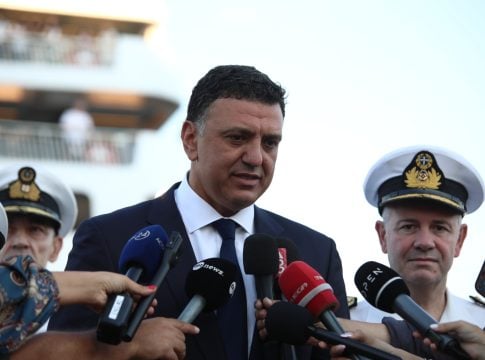

Bud Darr, president and CEO of the Cruise Lines International Association (CLIA), underlined the importance of stability in cruise markets, proper management of tourist flows and investment in infrastructure.
Responding to a question from “N” regarding the implementation of “disembarkation fees” in cruises in Greece, during a press conference at the CLIA European Summit 2026 taking place in Madeira, the head of CLIA, after emphasizing that his position concerns fees at a global level, noted that the industry’s attitude towards them depends mainly on how the revenues are used.
As he explained, fees associated with specific services or infrastructure projects that improve the passenger experience and the operation of companies are much more easily accepted by the industry. “When fees cover specific services or infrastructure that directly contribute to the cruise experience, they are much more acceptable than when they simply function as a tax,” he said.
On the contrary, there are cases where fees are named environmental or operational, without the revenue being reinvested in the industry or the destinations from which they come. In these cases, the result is simply an increase in costs, without any substantial benefit to the sustainability or management of tourism.
According to him, the increase in costs can lead either to unsustainable itineraries or to an increase in prices for passengers. However, he clarified that ultimately it is the market that determines ticket prices. “The customer is not interested in the cost. He is only interested in the amount he is willing to pay. When operating costs exceed the limits of the market, companies move their ships to other areas.”


Hypertourism
Bud Darr also argued that cruise fees are not an effective tool for managing tourism. As he explained, in many cases they do not lead to a decrease in total arrivals, but simply change the composition of visitors.
He cited Venice as an example, where, despite restrictions and fees for cruise ships, total visitor numbers have continued to increase. “Cruise ships are often targeted because they are visible, but they are often given more of the blame for the problem than they actually are,” he added.
At the same time, he acknowledged that the cruise industry has a responsibility in managing tourist flows, arguing that the sector can contribute substantially to better planning of arrivals.
Geopolitical uncertainty
He particularly emphasized the importance of stability and security for the cruise industry. As he said, unlike other shipping sectors, cruise itineraries are planned many years in advance, usually up to three years before their execution. Uncertainty can lead to ships leaving an area quickly, while their return requires much more time.
As typical examples, he mentioned developments in the Middle East and the Red Sea, where security issues led to a significant reduction in activity. Similar effects, he said, have also been recorded in ports in the Eastern Mediterranean during periods of tension. Passenger safety, he stressed, is always the first priority of companies.
Για να εμφανίζονται περισσότερα άρθρα της Ναυτεμπορικής στις αναζητήσεις σας εύκολα και γρήγορα, πρέπει να προσθέσετε το site στις προτιμώμενες πηγές σας. Μπορείτε να το κάνετε πηγαίνοντας εδώ.