
Four years have passed since the start of the Russian invasion of Ukraine, and there is no end in sight.
The conflict in Ukraine has now lasted longer than the Korean War and in three months will have surpassed World War I in duration.
When and how will this massacre, which has so far caused the deaths of hundreds of thousands of people on both sides, as well as incalculable destruction, end? This is undoubtedly a war of attrition, in which Russia has the upper hand.
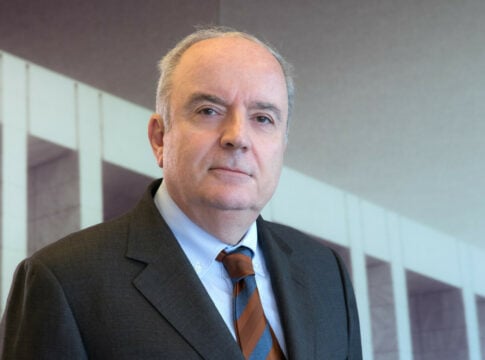
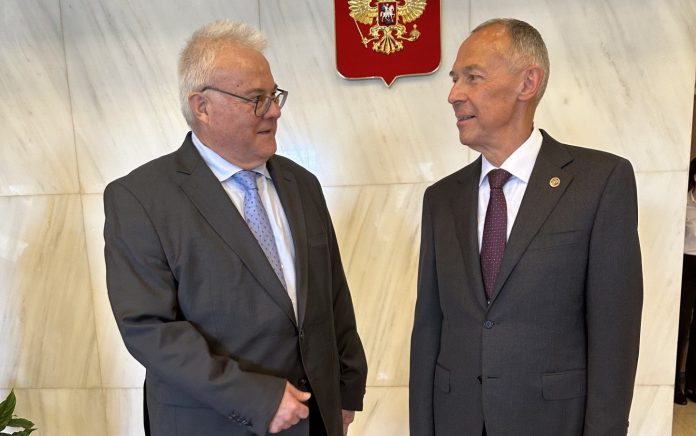
Four years – some 1,458 days of fighting – what does Russia seek to end this war? We asked this question, among others, to the Ambassador of the Russian Federation in Athens, Andrey Maslov.
“Mr. Psilos, Russia’s position on the end of the conflict in Ukraine, which was formulated by President Vladimir Putin as early as June 2024, remains unchanged. Its settlement is not possible without eliminating the primary causes of the crisis, without demilitarization and de-Nazification of Ukraine. Among other things, this presupposes that Ukraine remains a non-aligned, non-nuclear state, as well as the exclusion of any conditions for it to create threats to the security of the Russian Federation. In this context, the presence on Ukrainian territory of troops of Western countries under any flag is unacceptable. “NATO’s uncontrolled expansion towards our borders, including Ukraine, is one of the factors that led to today’s confrontation,” the Russian Ambassador said to Naftemporiki.


Russian conditions for peace
“A necessary condition for a stable peace,” according to Andrey Maslov, “is the elimination of the Nazi foundations of the Kiev regime. And here, in addition to the fight against ideology and the structures that support it, strong guarantees of respect for the linguistic, cultural and religious rights of Russians who still remain in Ukraine are necessary.
We must also take into account the will of the residents of the Donetsk and Luhansk People’s Republics, as well as the Zaporozhye and Kherson regions, who have made their choice in favor of reunification with Russia. All these positions, along with the lifting of illegal Western restrictions, must be recorded in the form of fundamental international agreements. Our priority is to achieve them through diplomatic channels.”
Mr. Ambassador, US President Donald Trump, through his special envoys, is trying to end the war through negotiations. Russian Foreign Minister Sergey Lavrov accused Trump of “betraying the commitments he made in Alaska to President Putin. What were those commitments?
“Mr. Psilos, in Anchorage, the leaders of Russia and the United States reached an understanding in principle on how to ensure a stable and long-term settlement in Ukraine, and the framework was established within which the results of the ongoing negotiation process should fall, including on the issue of restoring the rights of the Russian-speaking population.
At the same time, the American side stated that there are prospects for a broader mutually beneficial cooperation in the fields of economy and trade, which is hindered by the Ukrainian issue because it remains on the agenda.
However, attempts to undermine the “Anchorage agreements” are also being made by the Kiev regime and the Europeans who support it, with the aim of removing from the positions agreed in Anchorage the points that are of key importance to us.”
How does Moscow see Europe’s stance?
The European Union is planning its 20th package of sanctions against Moscow, but at the same time it seems that French President Emmanuel Macron and Italian Prime Minister Giorgia Meloni want to talk to Russia to find a solution. Is there any change in Europe’s stance?
The Russian Ambassador stated: “No, we do not see any change in Europe’s stance. In the current situation, it is difficult to take the statements seriously. This is probably not so much a matter of readiness for negotiations with our country, as an attempt to “interfere” in the negotiation process, to try to impose unacceptable settlement solutions on us that are promoted by the EU and the “alliance of the willing”.
Europe continues to provide multilateral assistance to the Kiev regime, including the supply of weapons to Ukrainian formations. Initiatives are being promoted that provide for the merger of the military forces of the EU and Ukraine. Discussions about the deployment of NATO forces there do not stop.
No mood for negotiations is being expressed, and the leadership of European institutions, on the contrary, is planning further demands on Russia regarding the terms of the settlement. Instead of attempts to listen to our positions, we see plans to further increase military spending and exert ever greater pressure with sanctions on Moscow under the pretext of protecting the Kiev regime and strengthening the security of the EU. Whereas, a real contribution to stability on the continent would be the elimination of the primary causes of the conflict in Ukraine,” the Russian ambassador emphasized.
A new security architecture in Europe
However, Russia is talking about a new security architecture in Europe. What does this mean, Mr. Ambassador?
“Mr. Psilos, the European security architecture that began to take shape in the 1970s of the last century is not functioning today. For some time now, the West has been following the path of dismantling its key links, including arms control agreements.
The blatant sabotage by a number of European countries led to the collapse of the Treaty on Conventional Armed Forces in Europe (CFE) and later the Open Skies Treaty. The OSCE serves exclusively the interests of European countries without taking into account the new global reality, and for this reason it has lost all credibility.
In these circumstances, in February 2024, the President of the Russian Federation V. Putin formulated the idea of forming a framework of equal and indivisible security in Eurasia,” he emphasized.
Greater Eurasian Partnership
The Russian Ambassador explained that “this system is based on an earlier idea of the Greater Eurasian Partnership. The initiative presupposes the harmonization of integration processes on the continent and the creation of a system of security guarantees for all countries and associations of Eurasia with the gradual withdrawal of foreign military forces from the region.
The future architecture should be open to all Eurasian states, including the member states of the European Union and NATO, which will be ready to abandon the hostile policy and recognize the non-negotiable nature of the principle of the indivisibility of security, which was proclaimed even within the framework of the OSCE. The reconstruction of an effective architecture is possible only with mutually beneficial and equal cooperation of all regional centers.”
Russian-Greece relations
The discussion with the Ambassador of the Russian Federation also covered the Greek-Russian relations. Historical, religious and economic relations, which have their roots centuries ago.
However, today and after the Russian invasion of Ukraine, Russia’s relations with Greece seem to be at the worst possible level. This was also recently supported by the Russian Minister of Foreign Affairs, Sergey Lavrov.
The spokesperson for the Greek Ministry of Foreign Affairs stressed, however, that “as Greece, we seek to maintain good relations with Russia and we wish in the future, when circumstances allow, for relations to be restored.”
The last question was whether he sees – when and how – relations between the two countries being restored.
“Indeed, Mr. Psilos, Russian-Greek relations are at their lowest point in the last 200 years of their history,” the Russian Ambassador said.
“The multilateral cooperation that distinguished them has been completely destroyed, and we are not responsible for this. Weapons are being sent to Ukraine. Almost daily, senior Greek officials make anti-Russian statements, express solidarity with the Kiev regime. That is why the question about the prospects for restoring relations should be addressed to those responsible for their destruction.
On our part, we are always ready to listen to constructive proposals regarding the restoration of cooperation. Russia is open to an equal and mutually beneficial dialogue with all partners,” Andrey Maslov emphasized to Naftemporiki.
Για να εμφανίζονται περισσότερα άρθρα της Ναυτεμπορικής στις αναζητήσεις σας εύκολα και γρήγορα, πρέπει να προσθέσετε το site στις προτιμώμενες πηγές σας. Μπορείτε να το κάνετε πηγαίνοντας εδώ.