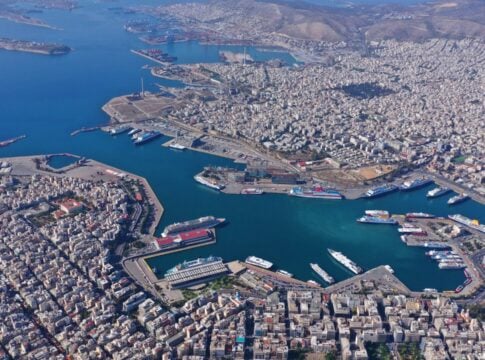

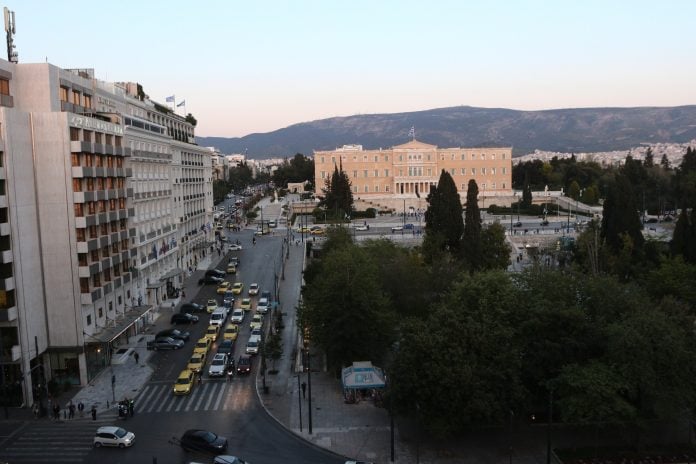
Market representatives have welcomed the U.S.-Iran agreement as a “summer gift” for the Greek economy, raising expectations for lower energy costs, softer inflation, more favorable financing conditions and stronger consumer spending.
According to the Piraeus Chamber of Commerce and Industry (PCCI), the agreement between the United States and Iran, provided it is fully implemented, could prove to be one of the most significant economic developments of 2026.
The reopening of the Strait of Hormuz, the temporary easing of oil-related sanctions and the release of Iranian funds are expected to create a new environment of de-escalation in energy and transportation markets. This, in turn, could reduce inflation in the euro area by between 0.3-0.8 percentage points over the next six months, the Chamber said.
Geopolitical Risk Premium in Fuel Prices Set to Ease
For Greece, a country heavily dependent on energy imports, with a strong shipping industry, export-oriented trade sector and a pivotal role in maritime transport, the agreement carries particular significance, according to the Piraeus Chamber of Commerce and Industry (PCCI).

The most immediate effect is expected to be a reduction in the “geopolitical premium” embedded in oil and natural gas prices. As risks in the Persian Gulf subside, pressure on fuel, transportation and production costs—and ultimately on consumer prices—is likely to ease.
The Chamber stressed that the Greek market has every reason to closely monitor developments, noting that energy costs are far more than just a household expense.
“Energy is a cost factor for industry, trade, transportation, logistics, tourism and shipping. Any decline in oil prices is eventually transmitted throughout the value chain, albeit with a time lag,” it said.
Relief for Small and Medium-Sized Enterprises
According to the PCCI, lower energy costs could provide much-needed liquidity relief for small and medium-sized enterprises (SMEs), which in recent years have been burdened by inflation, high interest rates, rising rents and elevated operating expenses.
The agreement could also support monetary policy easing in Europe. Should energy prices stabilize at lower levels, the European Central Bank would have greater room to pursue a less restrictive interest-rate policy. This would translate into cheaper financing, improved funding conditions and easier access to working capital and investment loans.
Positive Implications for Greek Shipping
For the real economy, these benefits could prove just as important as lower fuel prices. The shipping dimension is also significant.
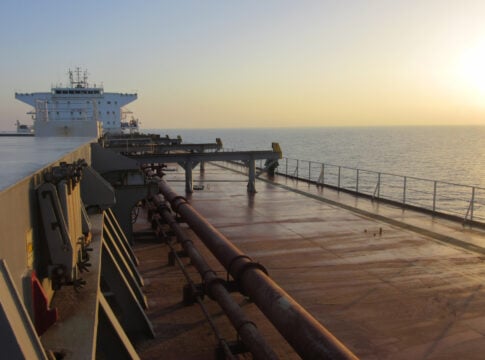
The Strait of Hormuz is one of the world’s most critical energy corridors. Restoring safe passage through the waterway would reduce risk premiums, delays, chartering costs and supply-chain uncertainty.
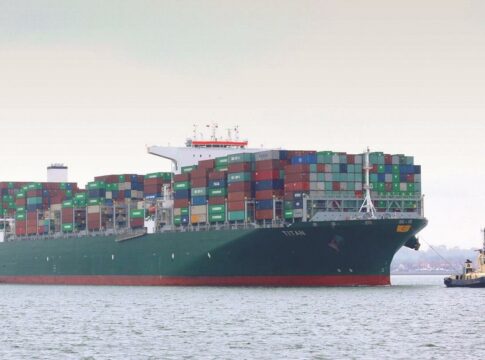
Greek-owned shipping, which maintains a strong presence in tanker markets and international energy transportation, stands to benefit from such normalization. Greek coastal ferry operators could also see meaningful fuel-cost relief ahead of the peak summer tourism season and increased sailing schedules.
As for Greek trade, the challenge is twofold: reducing import and transportation costs while capitalizing on the potential revival of economic ties with markets across the wider region.
“The Eastern Mediterranean, the Persian Gulf and the Middle East are not only regions of risk. They are also regions of trade, investment, energy, infrastructure and logistics. Greece can position itself as a bridge between Europe, the Mediterranean and Asia,” the Chamber noted.
The Key Challenge
The market, however, will judge the agreement not by its signing but by its implementation.
Domestic opposition within Iran, political dynamics in the United States, the stance of regional powers and the extent to which sanctions are effectively lifted will determine whether the de-escalation proves durable. Hardline reactions already emerging in Iran underscore the political fragility of the deal.
Against this backdrop, the Chamber argued that Greece should move proactively to recover exports to Lebanon and Arab countries, which exceed 3.2 billion euros annually.
“The government, businesses and institutions must seize this window of opportunity to reduce costs, boost exports, stabilize prices and accelerate investment. Businesses cannot simply wait for international prices to fall,” the PCCI said, adding that mechanisms are needed to ensure that lower costs are passed through to the market more quickly and become visible to the consumers.
Potential Catalyst for the Second Half of 2026
If it proves durable, the U.S.-Iran agreement could act as a positive catalyst for the second half of 2026.
It could help curb inflation, lower energy costs, support consumption, reduce pressure for further ECB rate increases and improve competitiveness. For the Greek economy—and SMEs in particular—it represents an opportunity that should be transformed from a diplomatic breakthrough into tangible economic gains.
Vassilis Korkidis: A Summer Gift for the Greek Economy
PCCI President Vassilis Korkidis described the agreement as “highly welcome” for the Greek economy and trade.
“It corresponds to a summer gift, offering lower energy costs, softer inflation, more favorable financing conditions, stronger consumption and a recovery in tourism bookings,” he said.
Korkidis noted that the agreement’s credibility will depend on two key indicators: the reopening of the Strait of Hormuz and the gradual return of Iranian oil to global markets.
If the agreement withstands political pressures and is fully implemented, he said, the second half of 2026 could mark a period of accelerated economic normalization.
When Will the Benefits Be Felt?
“Signing a U.S.-Iran agreement does not automatically mean a full return to normality,” Korkidis noted, emphasizing that energy markets, transportation networks and investment flows will require time to adjust.
According to his assessment, the first benefits could become visible within 30-90 days. A more meaningful easing of inflation and production costs is expected within six to 12 months, while the full realization of the agreement’s potential could take between 7-24 months, reflecting the time needed to restore oil infrastructure and normalize supply flows.
Για να εμφανίζονται περισσότερα άρθρα της Ναυτεμπορικής στις αναζητήσεις σας εύκολα και γρήγορα, πρέπει να προσθέσετε το site στις προτιμώμενες πηγές σας. Μπορείτε να το κάνετε πηγαίνοντας εδώ.