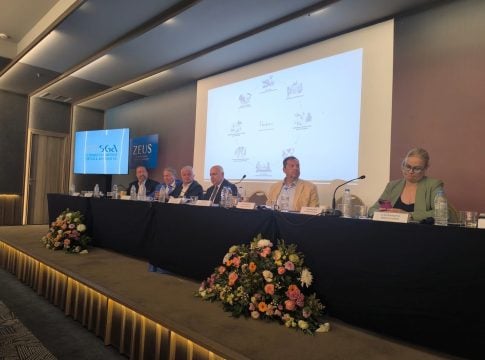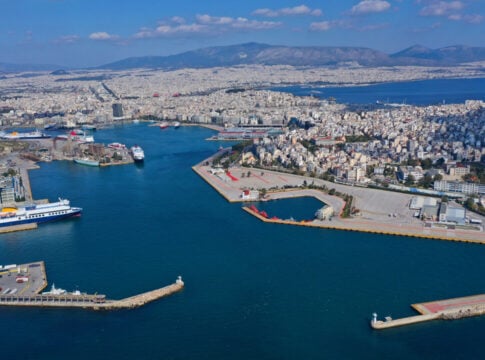

The strategic role of Greek ports and infrastructure in the new security architecture of the Eastern Mediterranean, as well as their prospects for further development, was analysed by participants in a panel discussion held at the Athens Defence Conference.
The Athens Defence Conference is organised by the Delphi Economic Forum in cooperation with the Hellenic Foundation for European and Foreign Policy (ELIAMEP).
Within this context, German Ambassador to Greece Andreas Kindl stressed that military mobility and infrastructure are key priorities for Europe, noting that Germany is systematically investing in the interconnection of transport networks.
He also acknowledged Greece’s pivotal role in the Eastern Mediterranean, highlighting Germany’s long-standing presence in Greek ports and its particular interest in areas such as Crete and Larissa.
Norwegian Ambassador to Greece Harriet E. Berg emphasised the importance of protecting critical maritime and subsea infrastructure, underlining that modern ports must be prepared not only for physical but also for digital threats such as cyberattacks. She also stressed the need for close cooperation between states, port authorities, the shipping industry and technology companies, as well as the development of cross-border infrastructure.


Support for Greek shipbuilding
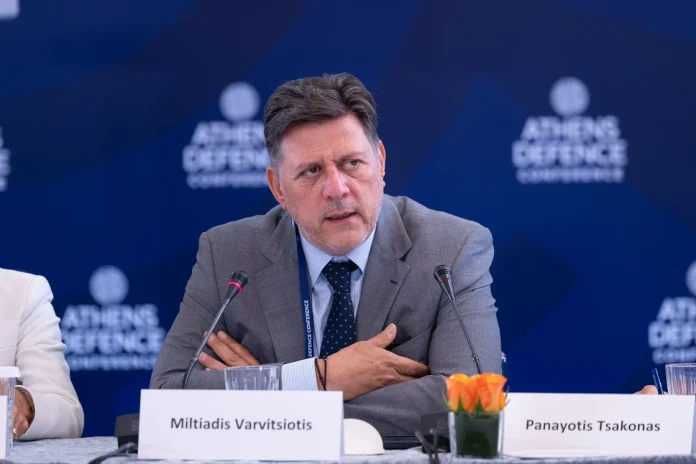
Miltiadis Varvitsiotis, Deputy Chairman and CEO of Skaramangas Shipyards, said the revival of the Greek shipbuilding industry could become a major growth driver for the country.
He argued that the Greek state should place greater trust in domestic production capabilities, noting that every euro invested in the Greek defence industry generates significant returns for the economy and can finance new technological investments.
He also supported the return of shipbuilding to Europe through more coherent European policies.
From transit country to strategic hub
Professor of International Relations and Security Studies at ELIAMEP Panagiotis Tsakonas highlighted Greece’s potential to evolve from a transit country into a strategic hub, leveraging its geographical advantages alongside political stability, port-to-hinterland connectivity and resilience against hybrid threats.
Energy strategy analyst and Academic Director of the Greek Energy Forum Greek Energy Forum Michalis Mathioulakis said that an energy infrastructure acquires real strategic value when it contributes to reducing a country’s dependence on third-party suppliers.
He added that Greek ports could play a decisive role in the energy sector, provided they integrate capabilities in electricity, natural gas, oil and other critical energy infrastructure.
Για να εμφανίζονται περισσότερα άρθρα της Ναυτεμπορικής στις αναζητήσεις σας εύκολα και γρήγορα, πρέπει να προσθέσετε το site στις προτιμώμενες πηγές σας. Μπορείτε να το κάνετε πηγαίνοντας εδώ.