
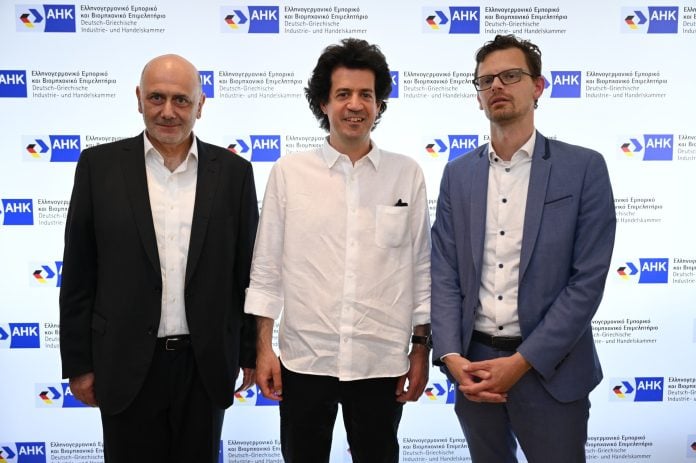
Greece must move beyond digitization and enter the era of artificial intelligence by investing in research and AI-powered public services, Konstantinos Daskalakis, Professor of Computer Science in the Department of Electrical Engineering and Computer Science at Massachusetts Institute of Technology, said during an event hosted by the German-Hellenic Chamber of Industry and Commerce following its annual general assembly.
Daskalakis made the remarks during a public discussion with Dr. Ilja Nothnagel, Director General and board member of the Chamber, focusing on the transformative impact of artificial intelligence on economies, businesses, governments and society.
The MIT professor noted that Greece has already made significant progress in digitization, particularly in improving interactions between citizens and the public sector. However, he said the next major challenge is the transition to a new generation of “smart” public services that leverage data and artificial intelligence to improve coordination among public agencies and deliver faster and more efficient services to citizens and businesses.
He also stressed the need to develop a strong Greek research and innovation ecosystem in artificial intelligence. While Greece possesses highly skilled talent and a solid scientific foundation, targeted policies and substantial investment are needed to build a dynamic research community capable of producing globally competitive knowledge, technology and innovation, he said.
Daskalakis added that Greece and Germany have significant opportunities for collaboration in technology and artificial intelligence, particularly in robotics and biotechnology, sectors that he said are expected to play a leading role in the future.


Addressing the impact of artificial intelligence on the economy and labor market, Daskalakis argued that human creativity will become increasingly valuable in a society and economy shaped by technology. Artificial intelligence, he said, can significantly enhance human capabilities without replacing the qualities that make people unique, most notably creative thinking.
He also highlighted AI’s ability to combine vast amounts of data and knowledge, rapidly identifying information, patterns and correlations. This, he said, enables deeper access to human knowledge and can serve as a powerful decision-support tool across a wide range of activities.
According to Daskalakis, modern AI systems can manage and coordinate complex datasets, transfer knowledge from data-rich fields to areas where information is scarce, and help improve understanding of complex phenomena. They can also identify new opportunities for research, development and business activity by uncovering areas where available data can be used more effectively.
The discussion underscored the pivotal role artificial intelligence is expected to play in the coming years in enhancing economic competitiveness, transforming businesses and modernizing the public sector. It also highlighted the need for Greece to invest systematically in research, innovation and digital skills in order to capitalize on the opportunities created by the new technological era and strengthen its competitive position.
Για να εμφανίζονται περισσότερα άρθρα της Ναυτεμπορικής στις αναζητήσεις σας εύκολα και γρήγορα, πρέπει να προσθέσετε το site στις προτιμώμενες πηγές σας. Μπορείτε να το κάνετε πηγαίνοντας εδώ.