

With a potential investment portfolio of around 1 billion euros over the next seven years, Chevron – HELLENiQ ENERGY signatures for new exploration areas south of Crete and the Peloponnese open a new page in the national hydrocarbons program.
In particular, the arrival of one of the leading American oil groups in Greek seas is accompanied by a doubling of the areas under investigation from 47.905 sq. km. at the end of 2025 to 96.094 sq. km. now, counting the 4 new plots “South of Crete 1”, “South of Crete 2” (totaling 35,000 sq. km.), “South of the Peloponnese” (11,000 sq. km.) and the small “A2” (826 sq. km.) which are also entering the “microscope” of the oil industry.
Timetable
As for the basic timetable, it is divided into two main periods, with the first starting around the end of 2026 and extending until 2032 with the implementation of seismic surveys (two-dimensional and three-dimensional) in the areas under investigation and then the “critical period 2032-2035” for the production of domestic hydrocarbons.
The final decision on whether or not to carry out exploratory drilling belongs to the companies and is taken following an assessment of the data obtained from the two-dimensional and three-dimensional seismic surveys, however, it is not a given that every concession will de facto proceed to the exploratory drilling stage.
Similarly, the carrying out of exploratory drilling does not de facto imply its success, with international experience indicating, in common practice, the need for repeated drilling in order to find an exploitable deposit.

In this light, the project remains demanding and complex, with the existing data allowing us to be optimistic about the further progress of the national hydrocarbon program, when an exponential increase in the collection of seismic data is now recorded with more than a doubling of the areas under investigation.
As for the four new areas, the existing “timelines” concern the implementation of the first phase (2D seismic surveys) in the next three years, starting in late 2026 and early 2027, to be followed by the second phase (3D seismic surveys) and the third phase, each lasting two years. There will be a differentiation in the case of “A2”, with the CEO of the Hellenic Hydrocarbons and Energy Resources Management stating that the Chevron and Helleniq Energy consortium will proceed directly to the implementation of three-dimensional seismic surveys.
It is worth noting that the aforementioned “maturation” schedule of the 4 new areas appears to be one year shorter than similar contracts in the past, a fact that in turn underlines the determination of the Greek State to exhaust in the best possible way the scope for development of the national program, as well as its determination to proceed to the end, when all previous relevant projects ended up being “marked” by significant delays.
Economic footprint
The volume of planned investments to make all this happen is also considered particularly significant, with the relevant “portfolio” already counting investments of around 176 million euros to date.
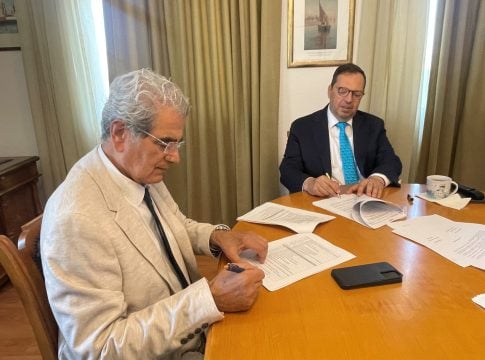
“Today, we are adding 41.5 million euros in commitments for seismic research investments. With the drilling in block 2, an additional 80 million euros in investments have been launched. In total, we have secured another 790 million euros for the execution of potential drilling, if all areas mature and reach this research stage,” the CEO of the Hellenic Hydrocarbons and Energy Resources Management said.
Regarding the benefits for the Greek State from the contracts, Aristofanis Stefatos mentioned, among other things, that 20% corporate tax and 5% regional tax are included. Payment of royalties depending on the scale of production, from 4% to 15%. Approximately 3.5 million from concession rights, estimating a potential revenue of 35 million over time. Overall, he estimated that approximately 40% of the revenue will be returned to the Greek state.
Greece emerges as a “strategic player” in the region
On his part, the Minister of Environment and Energy Stavros Papastavrou emphasized – during his greeting at the beginning of the event – the close connection between energy security and national security, with Greece emerging – taking into account the Vertical Corridor plans – as a “strategic player” in the region, even more so if exploitable deposits emerge in Greek seas that will turn the country from an importer to a producer of hydrocarbons today.
“We support energy realism in Greece and Europe,” he emphasized, adding that the country’s energy strategy seeks to holistically face the energy reality of which it is a part, with a corresponding special strategic weight from hydrocarbons and infrastructure to electrical interconnections within and across borders, RES and new technologies with the aim of “the fastest and highest quality transition to the digital world.”
“We are restoring our geopolitical stature and exercising our sovereign rights,” he stated in this regard, giving the stamp of the developments, with the American Ambassador Kimberly Guilfoyle positioning herself accordingly, highlighting the strategic cooperation between the two countries in the wake of the tectonic changes taking place in global affairs, with energy firmly at the forefront.
Για να εμφανίζονται περισσότερα άρθρα της Ναυτεμπορικής στις αναζητήσεις σας εύκολα και γρήγορα, πρέπει να προσθέσετε το site στις προτιμώμενες πηγές σας. Μπορείτε να το κάνετε πηγαίνοντας εδώ.