
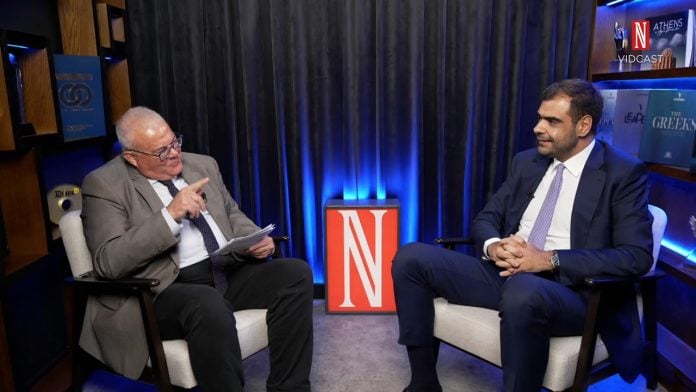
New Democracy’s sole electoral objective is securing an outright parliamentary majority, but “this is not an arrogant goal or an end in itself,” government spokesman and Deputy Minister to the Prime Minister Pavlos Marinakis said in an interview with Naftemporiki and Michalis Psilos.
Asked whether the ruling party would seek coalition partners if it failed to win an outright majority, Marinakis said the main opposition party PASOK, led by Nikos Androulakis, had already made its position clear.
“PASOK under Nikos Androulakis has already answered that question,” he said.
Marinakis underlined that abandoning a party’s core political identity “just to stay in office means you are defeated from the outset.”
Ahead of Prime Minister Kyriakos Mitsotakis’ annual policy announcements at the Thessaloniki International Fair (TIF) in September, Marinakis signaled further measures to support businesses, particularly small and medium-sized enterprises (SMEs).

“There now need to be interventions in favour of businesses, especially SMEs. I cannot say what the scope or the tax rate will be,” he said. “What I can say is that, following last year’s TIF, the time has come to provide further relief for those who consistently meet their obligations and for the middle class.”
He noted that last year’s TIF package amounted to the country’s most significant tax reform in years, with 80%-90% of the measures focused on income tax for employees, self-employed professionals and sole proprietors, who make up the vast majority of Greek businesses.
Marinakis argued that one of the government’s greatest domestic achievements has been reducing taxes while simultaneously increasing public revenues.
“We have a government that cuts taxes, increases revenues, creates jobs and reduces debt. That did not happen by chance,” he said. “For me, this is our greatest domestic success, aside from foreign policy.”
Looking ahead to the next election, Marinakis said the government would be judged on two fronts: its effectiveness in delivering reforms in areas such as healthcare, education and the economy, and its agenda for the next four-year term.
“Citizens will decide based on what we have delivered and on what we propose to do over the next four years,” he said.
Addressing the renewed conflict in the Gulf and its potential economic impact, Marinakis said the government remained concerned but did not believe there was reason for alarm.
“We are concerned about the further consequences of the war, but not in a way that creates panic. We believe the situation is fully manageable,” he said.
He acknowledged that government measures to cushion fuel price increases had been partly offset by renewed geopolitical tensions, although, without those interventions, prices would have risen even further.
Marinakis also highlighted Greece’s rapid expansion of renewable energy, noting that the use of renewables has increased by around 50% in recent years.
“This policy is paying off,” he said. “It does not mean people are unaffected by the crisis, but it has given the government the tools to limit the consequences of an unprecedented period of wars and crises. We are not living in normal times.”
“Fortunately, Greece has a government capable of managing these crises in the best possible way,” he concluded.
Για να εμφανίζονται περισσότερα άρθρα της Ναυτεμπορικής στις αναζητήσεις σας εύκολα και γρήγορα, πρέπει να προσθέσετε το site στις προτιμώμενες πηγές σας. Μπορείτε να το κάνετε πηγαίνοντας εδώ.