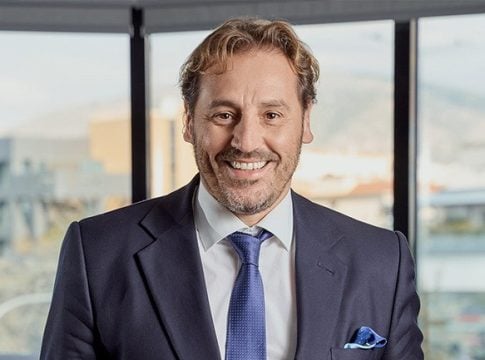

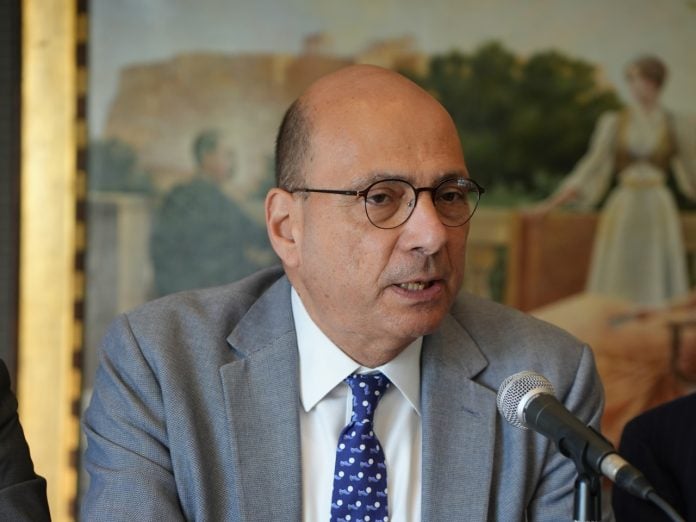
The need to treat critical and strategic raw materials as a major geopolitical, economic and technological issue was highlighted by Konstantinos Yazitzoglou, president of the Association of Mining Companies, at the Hellenic Survey of Geology and Mineral Exploration (EAGME) conference titled “Underground Solutions for Above-Ground Challenges” in Athens.
Geopolitical Dimension
Yazitzoglou said Western dependence on Asia for critical mineral raw materials remains extremely high, with the full extent of this vulnerability not yet fully recognized.
He noted that the European Union has identified 34 critical and strategic raw materials, with the geographical distribution of production highlighting China’s dominant position, as well as the significant role of countries including Russia, India, Indonesia and the Democratic Republic of Congo.
The broader BRICS group, together with countries where strategic mineral deposits are controlled by Chinese or Russian state-owned companies, accounts for between 33% and nearly 100% of global production of almost all critical raw materials, Yazitzoglou said. Only one of these materials has a global production concentration below one-third.
He stressed the geopolitical implications of the issue, noting that while the European Union seeks partnerships with countries that share common values and interests, strong alliances are simultaneously emerging among countries with different geopolitical orientations.

Concluding his remarks, the president emphasized that critical raw materials are not only linked to the energy transition.
“They form the foundation for the production of advanced defence systems, microchips, medical technologies, aerospace applications and, more broadly, the cutting-edge technologies that define the competitiveness, security and economic growth of nations in the 21st century,” he said.
Everyday Life and Production
The importance of the entire metals sector was highlighted by Athanasios Kefalas, former president of the Association and chairman of Imerys Greece.
Kefalas said the European Union’s continuously expanding list of critical raw materials — from 14 in 2011 to 34 today, with 17 also classified as strategic — demonstrates the growing recognition that mineral resources are fundamental to Europe’s economic development.
He stressed that so-called “non-critical” mineral raw materials remain equally essential for citizens’ daily lives and industrial activity.
From housing construction and major infrastructure projects to manufacturing, recycling, automotive production and dozens of modern applications, materials such as aggregates, cement, steel, perlite, talc, bentonite and attapulgite form an integral part of the economy’s value chain.
“If it can’t be grown, it must be mined,” participants emphasized, underscoring that all minerals — regardless of their classification — represent the first and necessary stage of the value chain for every product, infrastructure project and technology underpinning modern life.
Για να εμφανίζονται περισσότερα άρθρα της Ναυτεμπορικής στις αναζητήσεις σας εύκολα και γρήγορα, πρέπει να προσθέσετε το site στις προτιμώμενες πηγές σας. Μπορείτε να το κάνετε πηγαίνοντας εδώ.