
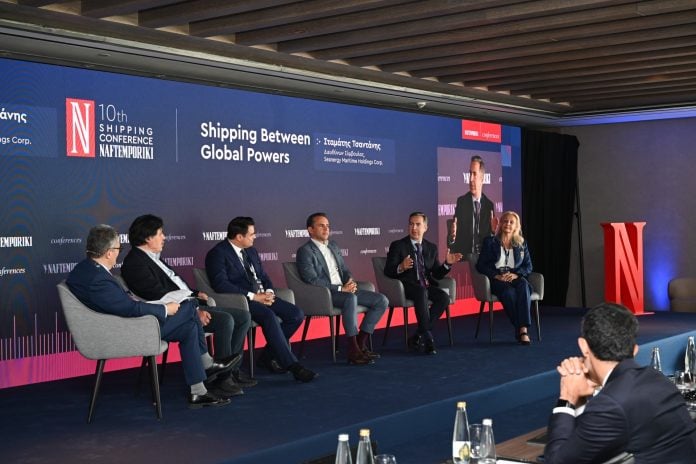
Geopolitical developments and shifting power balances affecting maritime routes, trade flows, and the operational environment of international shipping were at the center of the “Geopolitics at Sea: Shipping Between Global Powers” panel at Naftemporiki’s 10th Shipping Conference.
The panel participants included:
- Costas Delaportas, CEO, DryDel Shipping
- Yiannis Dragnis, CEO, Goldenport Holdings Inc.
- Savvas Kalenteridis, Geopolitical analyst, author, and host of the “Geopolitics” show on Naftemporiki TV
- Christina Margelou, Head of Shipping Finance, Eurobank
- Stamatis Tsantanis, CEO, Seanergy Maritime Holdings Corp.
- The panel was moderated by Antonis Lagadianos, Managing Partner and Founder of LCI Law.
Opening the discussion, Lagadianos explained that there is a universal perception that shipping has been transformed into a geopolitical tool and a means of leverage in recent years, driven by ongoing instability. He stressed that the latest geopolitical instability is the war in the Middle East, which led to the closure of the Strait of Hormuz for nearly three months. He also pointed out that if the situation does not normalize quickly, market conditions will certainly worsen.
Kalenteridis: Iran was gifted a “nuclear weapon”—the control of the Strait of Hormuz
Savvas Kalenteridis, Geopolitical analyst, author, and host of the “Geopolitics” show on Naftemporiki TV, stated that geopolitics centers on the control of sea lanes, which directly impacts shipping. “We also saw in the Russia-Ukraine war that shipping is being targeted,” he stressed, while focusing on the closure of the Strait of Hormuz. He noted that “a huge miscalculation was made. While the primary goal of the war was to prevent Iran from acquiring nuclear weapons, they gifted it a ‘nuclear weapon,’ which is the control of the Strait of Hormuz.”
“It seems difficult to change the status quo being built by the Revolutionary Guards in cooperation with Oman, unless we have a regime change. I believe those involved in the sector must adapt their strategies to the baseline scenario that the Strait will be under control and transits through it will be subject to tolls,” he emphasized.


Tsantanis: A “wake-up call” to reduce dependence on energy sources vulnerable to geopolitics
Stamatis Tsantanis, CEO of Seanergy Maritime Holdings Corp., pointed out that in the short term, the closure of the Strait of Hormuz causes an increase in fuel prices and a reduction in the availability of many raw materials.
He noted, however, that this can serve as a “wake-up call” to break the dependence on energy sources affected by geopolitics. “In other words, it drives countries to become more autonomous regarding renewable energy sources,” he clarified.
Dragnis: Free movement at sea is being disrupted
Yiannis Dragnis, CEO of Goldenport Holdings Inc., also expressed fears that tolls will be imposed on the Strait of Hormuz, pointing out that the free movement of vessels at sea is being disrupted.
He further noted that the situation changes daily and requires flexibility to deal with emerging problems. “And most of the time, Greek companies are very good at this and adapt very quickly,” he remarked, adding that this is one of the reasons why the shipping sector remains strong.
Delaportas: Charterers and shipowners must have excellent cooperation
Costas Delaportas, CEO of DryDel Shipping, noted that the psychological pressure on crews trapped in the Strait of Hormuz is immense. “We stood by our people, giving them bonuses and daily free internet to speak with their families. There was a tremendous bureaucratic hurdle in transferring crews to Dubai,” he pointed out, adding: “Fortunately, after a tremendous effort, we managed to free them. They went back to the Philippines. Their families were in tears when they saw them.”
He also emphasized that charterers and shipowners must maintain excellent cooperation to overcome the problems that arise on a day-to-day basis.
Furthermore, he warned of serious issues regarding the availability of fuel and lubricants. He even suggested the adoption of slow steaming, noting that if 30,000 ships reduced their speed, up to 300,000 tons of fuel could be saved per day.
“I would suggest that shipping bodies like the IMO institute slow steaming for vessels. If you consider that we save 8 to 10 tons of fuel per day moving from eco speed to full speed, you can calculate how much fuel we would save across the 30,000 ships we have globally,” he stressed.
Margelou: We look to keep the bank’s portfolio balanced
Christina Margelou, Head of Shipping Finance at Eurobank, pointed out that the golden key for shipping is commitment and relationships. “For us at Eurobank, this is our model. We care about the client. Of course, we care about the vessel too, but essentially, we first look at who the shipowner is,” she emphasized.
She also added that “we try to keep the bank’s portfolio balanced, meaning that it is distributed across different sectors. This way, our risks are also spread out to some extent.”
Για να εμφανίζονται περισσότερα άρθρα της Ναυτεμπορικής στις αναζητήσεις σας εύκολα και γρήγορα, πρέπει να προσθέσετε το site στις προτιμώμενες πηγές σας. Μπορείτε να το κάνετε πηγαίνοντας εδώ.