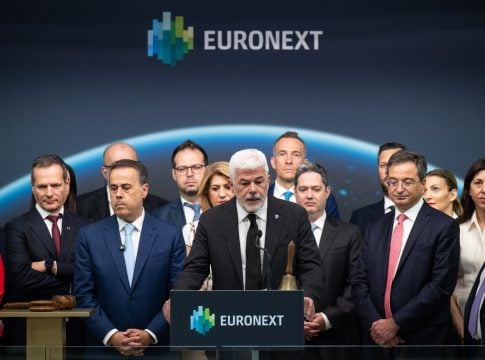


George Karageorgos, Head of Freedom24 in Greece, spoke to Naftemporiki about the challenges of 2026, analysing the profile of the Greek investor who is gradually moving away from bank deposits in favour of international markets, and explaining why diversification has become the only effective defence against market volatility.
Ongoing geopolitical tensions in the Middle East are having a significant impact on global markets. What is the most appropriate approach for a retail investor seeking to maintain portfolio balance and mitigate risk, as far as possible?
The crisis in the Middle East and the uncertainty surrounding the Strait of Hormuz highlight how rapidly geopolitical developments can affect financial markets. At present, we are observing a degree of stabilisation at elevated oil price levels with signs of balancing; however, should the situation remain fragile, we cannot rule out renewed inflationary pressures that could influence monetary policy. Markets, after all, tend to react not so much to war itself, but to its economic consequences—primarily energy prices.
For a retail investor, the key principle is not to react impulsively to developments, but to remain composed and act strategically. In the short term, uncertainty around the Strait of Hormuz continues to provide support to oil and gold prices, while specific bonds or equities in sectors such as defence, cybersecurity, and energy may also benefit.
History shows that markets recover when energy pressures prove temporary. Conversely, a more prolonged or severe disruption in oil supply could lead to higher inflation and a more cautious stance from central banks. Therefore, an investor’s strategy should be grounded in a long-term horizon, focused on investment products that are not negatively affected by geopolitical tensions, and supported by continuous monitoring of energy market developments. Proper preparation enables portfolios to withstand uncertainty without taking on excessive risk.

In light of the new 10% tariffs imposed as of 24 February 2026 under Section 122 (with President Trump and the USTR signalling an increase to 15% where applicable), how are global investors affected overall, and more specifically European and Greek investors?
The new US trade policies and tariff measures represent a source of uncertainty for global investors. The sectors most affected are those heavily reliant on exports to the US market, such as the European automotive industry and certain high-value consumer goods segments. These companies may face higher costs or reduced competitiveness.
However, market reactions two months after implementation have been relatively calm, as a significant portion of the associated risk has already been priced in. Investors are increasingly treating tariffs as a manageable structural risk within global trade rather than an immediate systemic threat to the European economy. For Greek investors, the key is to carefully assess the revenue sources of the companies they invest in. Businesses with strong domestic exposure or stable cash flows—such as infrastructure, services, or the financial sector—are generally less exposed to such trade tensions.
In recent months, Bitcoin has exhibited extreme volatility, while software stocks have experienced a sharp and sustained correction. What alternative strategies would you recommend for investors to protect themselves from similar market turbulence?
Indeed, the recent period has been a clear example of how rapidly the investment landscape can shift. On one hand, Bitcoin has shown significant fluctuations, reflecting both changing liquidity expectations and shifting investor appetite for risk assets. On the other hand, software equities have come under pressure as the market reassesses valuations and the pace at which AI is translating into tangible earnings within business models. The simultaneous volatility in crypto and technology highlights how vulnerable portfolios can be when overexposed to a limited number of sectors.
In such an environment, the key requirement for investors is proper portfolio construction to mitigate the impact of such shocks. A balanced approach may include high-quality equities with strong cash flows, investment-grade corporate bonds with medium duration, and a portion allocated to defensive assets such as gold. In simple terms, diversification is not merely a theoretical concept—it is the fundamental tool for protecting against market volatility.
With the Greek economy expected to grow by approximately 1.8% in 2026, supported by investments from the Recovery and Resilience Facility and ongoing digitalisation, what are the most promising trends and sectors for Greek investors?
The Greek economy is on an upward trajectory, primarily driven by Recovery Fund investments and the acceleration of digital transformation, with a gradual shift from the planning phase to the implementation phase of projects. This creates opportunities across multiple sectors. The expansion of artificial intelligence and digital infrastructure continues to enhance investment potential in companies leveraging technologies such as cloud computing and data analytics to boost productivity and improve efficiency.
It is also worth noting that the Greek stock market is showing increased interest in companies operating in energy, infrastructure, transport, exports, and retail—sectors benefiting from the broader resilience and recovery of the economy, as well as from improved profitability in specific segments such as banking. Naturally, as seen in recent geopolitical developments in the Middle East, conditions can change rapidly and indirectly affect the investment environment through increased volatility. For this reason, it is important for investors to build diversified portfolios that are not overly concentrated in a single sector.
With the Greek investment community maturing rapidly (over 128,000 Freedom24 users in Greece) and many investors shifting from deposits to international markets, what is the profile of the modern Greek investor in 2026, and what are the main investment options offered by Freedom24?
The profile of the Greek investor has changed significantly in recent years. Traditionally, a large share of savings was held in bank deposits. Today, however, an increasing number of individuals are turning to investments in search of higher income potential. This shift is also reflected in the growth of Freedom24, which has surpassed 128,000 users in Greece in less than four years.
The modern Greek investor is more informed and internationally oriented. They are often in their mid-30s, invest via online platforms, and focus primarily on international markets, with particular interest in US equities and ETFs.
The Freedom24 platform helps investors gain access to more than one million investment products across 15 international stock exchanges, including the Athens Stock Exchange. Through the platform, users can invest seamlessly and combine opportunities from the domestic economy with the dynamics of global markets, while also benefiting from local support and a fully Greek-localised environment.
What is the strategic importance of Freedom24’s Greek office in Athens, particularly in periods of heightened uncertainty such as the current environment?
Freedom24’s Athens office holds strategic significance, especially during periods of increased volatility in global markets. Its core role is to act as a “bridge” between Greek investors and global capital markets, providing not only technological access but also information, education, and local support.
The Greek office enables Freedom24 to better understand the needs of the domestic market and to offer more targeted services, contributing to the development of a more informed and active investment community.
At the same time, the Athens office strengthens investor confidence in a digital international investment platform by combining access to a broad range of global products with a physical presence and Greek-language support. In this way, Freedom24 aims to play an active role in the gradual development of investment culture in Greece.
Για να εμφανίζονται περισσότερα άρθρα της Ναυτεμπορικής στις αναζητήσεις σας εύκολα και γρήγορα, πρέπει να προσθέσετε το site στις προτιμώμενες πηγές σας. Μπορείτε να το κάνετε πηγαίνοντας εδώ.