
Greece has a four-month deadline—until the end of August—to meet the milestones and funding targets under the Recovery and Resilience Facility, as no extension will be granted, European Commissioner for Economy, Productivity, Implementation and Simplification Valdis Dombrovskis stressed in an exclusive interview with Naftemporiki.
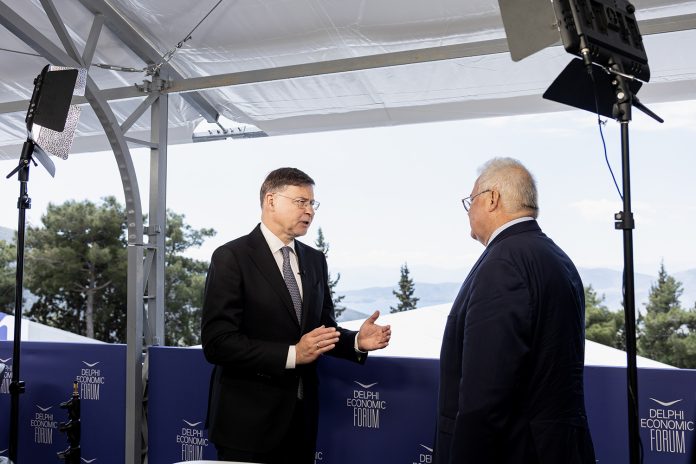
“At this stage of the multiannual framework, we are seeing increased deployment of cohesion policy funding,” he explained. The Latvian Commissioner was interviewed on the sidelines of the Delphi Economic Forum XI, where he was among the key invited speakers, given his responsibility for ensuring consistent implementation of fiscal rules across EU Member States under the Stability and Growth Pact.
Dombrovskis noted that “the Greek economy is in good shape, with growth exceeding EU average growth rates, a strong fiscal position, a budget surplus, and a rapidly declining debt-to-GDP ratio. Of course, it is important to stay on this path and build on these achievements.” Asked whether there is any consideration of relaxing the strict Stability and Growth Pact, he stressed that “the general escape clause exists only in the event of a severe economic downturn in the EU or the euro area as a whole. At present, we are not in that scenario. We are in a situation of economic slowdown, but not downturn.”
He acknowledged, however, that a negative economic impact on the European economy is expected, ranging between 0.2 and 0.6 percentage points, alongside an increase in average inflation that could exceed one percentage point, potentially resulting in a stagflationary shock to the economy.
Regarding the energy crisis and support measures for households and businesses, Dombrovskis reiterated the Commission’s recommendation that measures should remain temporary and targeted, focusing support on the most vulnerable households and the most affected industries.


The full interview to Michalis Psilos follows:
-There have been two months since the outbreak of the conflict in the Gulf, and its consequences are already evident for both the European and Greek economies.
“Indeed, we have estimated the potential economic impact of the conflict in the Middle East on the European economy.
This conflict, along with the blockade of the Strait of Hormuz, is generating significant effects, as it represents an external energy supply shock that we are facing. Energy prices are at particularly high levels, and there is, of course, considerable uncertainty. The economic impact will depend on the duration of the conflict and the magnitude of the price shock.
We have estimated what this could mean for the European economy, under different scenarios regarding how long the conflict lasts and how severe the energy price shock becomes.
We expect a negative economic impact on the European economy in the range of 0.2-0.6 percentage points of GDP, alongside an increase in inflation, depending on the scenario, which could exceed one percentage point.”
-So, in a sense, we are facing a stagflationary shock for the economy.
“To compare, before the war in Iran, our estimates for the growth of the European Union was 1.5%, both this year and next year. We will update our economic projections in the second half of May, and by then we will likely have a clearer picture of developments—whether there will be de-escalation regarding Iran, and whether the Strait of Hormuz will have safely reopened. Based on the available data, we will be able to make a new economic forecast.”
We are talking about the deepest energy crisis in 50 years, I assume. What measures has the Commission adopted based on these developments?
“First of all, what we are seeing is once again volatility in fossil fuel prices, already since 2022, during the previous energy crisis…”
With the Russian invasion?
“Exactly—following Russia’s invasion of Ukraine, we had already taken measures to strengthen our resilience. We now have a higher share of renewables, better interconnections, and greater capacity for alternative supplies. As a result, we are more resilient today in absorbing this energy shock. At the same time, it is clear that a policy response is required, primarily in the energy sector. This week, the European Commission published a report titled ‘Accelerate EU’, which outlines our response.
There are several measures, including coordinated release of oil reserves to maximize the positive impact, further integration of energy grid interconnections, and a temporary state aid framework allowing Member States to support the most affected industries.
However, in terms of a broader policy response, our recommendation is that measures should remain temporary and targeted. Support should also focus on the most vulnerable households and the most affected industries.”
Greek Prime Minister Kyriakos Mitsotakis has stressed that Europe needs a “plan B” if the crisis spreads. How do you view this?
“It is clear that we must monitor the situation very closely and respond as necessary. In that sense, we set the parameters of the current situation and the appropriate crisis response. I would say that the advice we give as the European Commission to EU Member States is also largely aligned with that of the International Monetary Fund to the broader international community. However, if the situation deteriorates, additional measures may of course be required.”
The Recovery and Resilience Facility enabled Greece to finance investments and programs that supported growth. The Facility will be finalized in four months, and the question is whether there will be any other financing instrument to replace it.
“Indeed, the Recovery and Resilience Facility is finalizing this year. All milestones and targets have to be met by the end of August, and all payment requests must be submitted by the end of September.
By the end of December, the Commission’s mandate to borrow from the markets for the purposes of this program will also end. So the program will come to an end this year.
It is, however, positive that we are currently at a stage in the multiannual framework where we are seeing increased momentum in cohesion policy funding.
Negotiations on the next Multiannual Financial Framework for 2028–2034 are already underway. Greece has so far received approximately 25 billion euros under the Recovery and Resilience Facility, corresponding to 68.3% of its total allocated grants.
The government is preparing its next steps for the submission of the 8th and 9th payment requests by the end of August.
In August, the 8th request for loans will be submitted upon completion of 10 milestones, along with the 9th request for grants, which requires the fulfilment of 133 milestones and targets—a record number.
By August 31, Greece must have met all 294 milestones and targets. The progress of the payment requests will be assessed against a total of 177 milestones that must be completed by the end of August.”
You have clearly discussed all of this with Prime Minister Kyriakos Mitsotakis during your meeting in Athens, as well as with Finance Minister Kyriakos Pierrakakis in Delphi. What is your message to the government regarding the state of the Greek economy?
“Yes, I met with Prime Minister Mitsotakis at the Maximos Mansion and twice with Finance Minister Kyriakos Pierrakakis. The message is that, overall, the Greek economy is in good shape, with growth exceeding the EU average, a strong fiscal position, a budget surplus, and a rapidly declining debt-to-GDP ratio.
There has therefore been a notable recovery. Of course, it is important to stay on this path and build on these achievements.
Greece has also made very effective use of the Recovery and Resilience Facility funds for investments, as well as for advancing its reform agenda. It has been a very successful development, and it is important to continue building on it.”
Commissioner Dombrovskis, as we conclude this interview, may I ask whether you are optimistic about the outlook for the Greek economy?
“Yes. Greece is certainly performing significantly better than many other European countries at the moment.”
Fuel price volatility
Valdis Dombrovskis also serves as Commissioner for Implementation and Simplification. His mandate is therefore to reduce the administrative burden on both citizens and businesses, and to ensure that EU rules are better implemented and enforced.
So what is he doing in the context of these responsibilities? Speaking alongside Finance Minister and Eurogroup President Kyriakos Pierrakakis at the Delphi Forum, Dombrovskis noted that the Commission has set ambitious targets to reduce the overall administrative burden by 25% for all businesses and by 35% for SMEs. This would translate into annual administrative cost savings of approximately 37.5 billion euros. “We have made a strong start, but we still have a way to go to reach the 37.5 billion euro target.”
“What we are doing,” he told Naftemporiki, “our strategic objectives—the European Green Deal, decarbonization, reducing dependence on fossil fuels—are fully consistent with what we need as a response to the current crisis. Because, once again, the source of the problem is the volatility of fossil fuel prices. The challenge today stems from this volatility. Therefore, we should not move away from policies that reduce our dependence on fossil fuels. That would be contrary to what we want to achieve.”
Is there any thought about the relaxing of the stability pact, for example?
“Well, there have been some discussions regarding the activation of the so-called general escape clause, but it must be said that the general clause exists only for a scenario of a severe economic downturn in the EU or the euro area as a whole. At present, we are not in this scenario. We are in a scenario of economic slowdown, but not downturn. Fiscal space is limited, which is why we are not moving towards a direction of broad, untargeted fiscal measures.”
Για να εμφανίζονται περισσότερα άρθρα της Ναυτεμπορικής στις αναζητήσεις σας εύκολα και γρήγορα, πρέπει να προσθέσετε το site στις προτιμώμενες πηγές σας. Μπορείτε να το κάνετε πηγαίνοντας εδώ.