
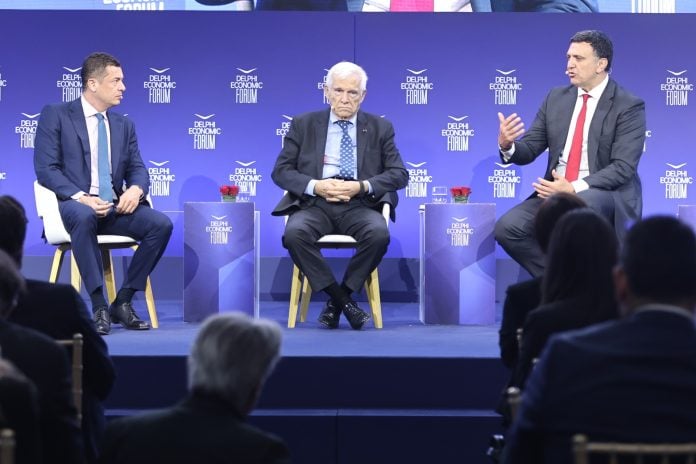
Maritime Affairs and Insular Policy Minister Vassilis Kikilias voiced Greece’s strong reservations over the European Union’s decarbonization framework for shipping, while underscoring the need for a more realistic, economically and socially grounded approach, during his intervention at the Delphi Economic Forum 2026.
As he noted, Europe is designing the sector’s transition with a multi-decade horizon, placing emphasis on alternative fuels and decarbonization targets, without adequately addressing immediate market challenges and real-world implementation constraints. “Many of these measures are not feasible,” he stressed, highlighting the need to strike a balance between ambition and realism.
The minister warned that the imposition of extensive taxation to achieve zero emissions—at an estimated cost of up to 130 billion euros by 2027 and between 100-300 billion euros by 2035—poses significant risks to the economy. He pointed out that these costs would ultimately be passed on to charterers and, in turn, to the real economy, leading to higher prices and intensifying inflationary pressures. “Europe is already being tested by rising costs, conflicts, and the energy crisis. Such an additional burden cannot be placed on societies,” he underlined, calling for a common-sense approach and the identification of viable, implementable solutions.
Shipping through the Strait of Hormuz under heightened risk
Referring to the seriousness of the situation in the Strait of Hormuz and its immediate implications for global shipping and the economy, Kikilias described conditions as comparable to a conflict environment, posing elevated risks to international navigation.
He emphasized that the protection of human life and seafarers remains the top priority, noting that the crisis is unfolding at one of the most critical geostrategic chokepoints for the energy supply chain and global trade.

“Between 80% and 90% of global trade is transported by sea, while under normal conditions approximately 20% of the world’s oil and 25% of natural gas transit through the Strait of Hormuz,” he said.
The minister underlined that disruptions to energy and raw material flows are amplifying pressures on the global economy, warning that the longer the crisis persists, the greater the risks to energy security and everyday life.
11 Greek-flagged vessels currently in the Persian Gulf
He also made specific reference to the presence of Greek vessels in the region, noting that 11 Greek-flagged ships—one tugboat and ten tankers—are currently operating within the Persian Gulf, while an additional 27 vessels are located outside the Strait.
The ministry remains in constant communication with crews, up to three times daily, ensuring the provision of guidance and support.
At the same time, he noted that repatriations of seafarers who requested to return have already been carried out, assuring that “all those who wished to return have done so.” He added that crews have adequate supplies, as many vessels are currently at anchorage.
However, Kikilias expressed his concern over maritime safety, referring to the dozens of vessels that have come under attack in the wider region, either by drones or missiles.
He stressed that although Greece does not have direct jurisdiction over foreign-flagged vessels, there is continuous monitoring of developments and ongoing efforts to safeguard Greek seafarers.
“No one can predict when this situation will end or what the later repercussions will be,” he concluded, emphasizing that operating in a conflict zone entails persistent risks for crews and requires heightened vigilance from all parties involved.
Για να εμφανίζονται περισσότερα άρθρα της Ναυτεμπορικής στις αναζητήσεις σας εύκολα και γρήγορα, πρέπει να προσθέσετε το site στις προτιμώμενες πηγές σας. Μπορείτε να το κάνετε πηγαίνοντας εδώ.