
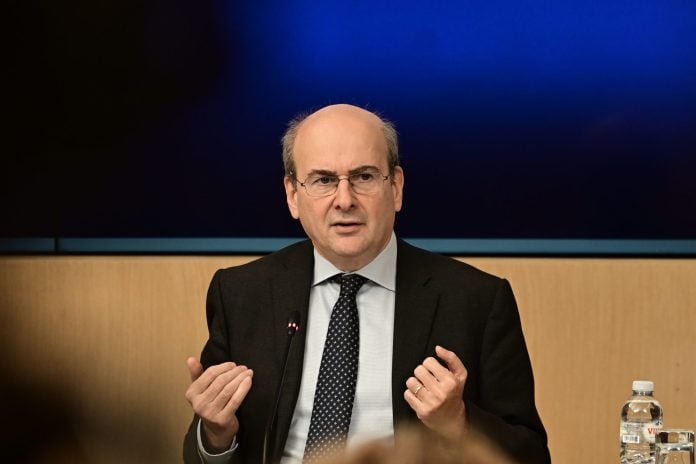
The Greek priorities for the new Common Agricultural Policy (CAP), as well as Greece’s negotiating positions in view of the decisions on the new European budget, were unveiled by the Deputy Prime Minister, Kostis Hatzidakis.
“The discussion on the new Common Agricultural Policy (CAP) for the 2028-2034 period is not limited to direct payments. It also concerns the future of agricultural production and the productive base of our country, food security, regional development and rural cohesion, as well as environmental balance. And, of course, it concerns the support of producers operating under challenging cost and competitiveness conditions,” Deputy Prime Minister Kostis Hatzidakis said on Tuesday, speaking at an event launching the consultation process on the new CAP, organised by the Ministry of Rural Development and Food.
“The dialogue,” he added, “is taking place at a time when long-standing structural problems in the sector are meeting new challenges, calling for solutions not only to past weaknesses but also to the creation of a meaningful future perspective.”
5 priorities for the new CAP and the agricultural policy
Hatzidakis outlined five key priorities for the new CAP and for agricultural policy more broadly:
First, agricultural policy should serve multiple parallel objectives, including:
– ensuring fair and adequate income for producers,
– linking the competitiveness of agricultural production with sustainability and food security,
– promoting investment in infrastructure, technological upgrading, innovation and resilience, and
– encouraging the renewal of human resources in farming, so that young people can live in rural areas with prospects.


Second, the new CAP framework at a European level should be simpler, more stable and easily understood by all stakeholders – producers, institutions, public authorities and local communities – without additional bureaucracy or ambiguity. “We want to help the primary production sector take steps towards modernisation and progress in practice, not burden it with complex – and often pointless – regulations, even on obvious matters,” he noted.
Third, a shift in approach is needed, focusing not only on the absorption of EU funds but also on their allocation and the outcomes they deliver. “This is a difficult discussion, but one we can no longer avoid – especially if we genuinely want to support agricultural production in our country,” he said.
Fourth, in recent months there has been a great deal of discussion about the implementation of a new system for the payment of agricultural subsidies with the transition from OPEKEPE to AADE. “Implementing it already in the near future is a big bet, and will lay the foundations for more transparency and reliability in payments and controls during the next period. We are not talking about less money. The same money will be shared in a fairer way in favor of real producers.”
Fifth, the entire discussion about the transformation of the primary sector in Greece should not be limited to the CAP. “The primary sector, either taking advantage of European policies or within the framework of national guidelines, needs to escape from a subsidy management logic, and take steps forward,” emphasized Hatzidakis. These steps include: larger and sustainable farms. Training and lifelong learning of farmers. Cooperation of farmers, through producer groups, clusters, agricultural chambers. Utilization of agronomists and veterinarians as real advisors to farmers in the field, and not as cashiers of subsidies and compensations, as they are to some extent today. Adaptation to climate change, with organized interventions for more resilient crops and production methods and sustainable management of water resources.
Greece’s positions in the negotiations
Referring to the negotiations on the new Multiannual Financial Framework (MFF) for the 2028-2034 period – which includes the new Common Agricultural Policy (CAP) – the Deputy Prime Minister and Chair of the Interministerial Committee coordinating the negotiations noted that they are likely to conclude while Greece holds the Presidency of the European Union at the end of 2027.
First, securing the maximum possible allocation of resources from all funding instruments under the EU’s new budget. “This is a challenging negotiation, as many Northern European countries consider the European Commission’s proposal already sufficiently generous.”
Second, safeguarding funding for the traditional pillars of Cohesion Policy and the CAP. “For us, these two policies remain of fundamental importance,” he underlined.
Third, ensuring that the introduction of new Own Resources is designed in a way that guarantees stable revenues without imposing a fiscal burden on mid-income member states such as Greece. “Because what matters is not only what you receive, but also what you contribute.”
“The outcome of this critical negotiation will determine Greece’s development prospects in the years ahead,” Hatzidakis concluded. “Both for the new CAP and for the 2028-2034 Multiannual Financial Framework, Greece is preparing with seriousness and a structured approach, and is actively participating in the negotiations. We want the consultation process to be substantive, not partisan, and to shape a national strategy that serves the long-term interests of Greek agriculture and rural regions.”
Για να εμφανίζονται περισσότερα άρθρα της Ναυτεμπορικής στις αναζητήσεις σας εύκολα και γρήγορα, πρέπει να προσθέσετε το site στις προτιμώμενες πηγές σας. Μπορείτε να το κάνετε πηγαίνοντας εδώ.