
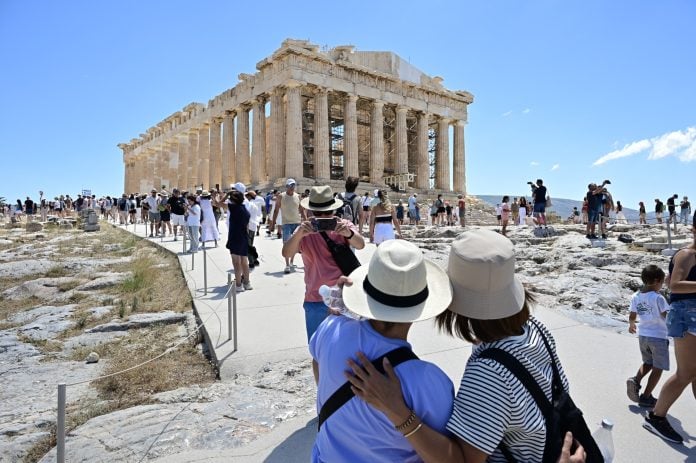
Greek tourism remains on an upward trajectory this year following last year’s record performance, with last-minute bookings expected to play a decisive role in determining whether the sector reaches new highs.
Despite a softer-than-expected performance in May and June, July has started strongly for several of Greece’s most popular destinations, including Crete and Mykonos. However, some destinations continue to lag behind last year’s levels, even during the peak season, with Santorini among the most notable examples.
The conflict in the Middle East has increased economic uncertainty globally and contributed to higher airfares, prompting many travellers to delay their holiday decisions and book closer to their departure dates. Industry participants say last-minute reservations have begun to pick up with the start of July.
Most hoteliers expect tourist traffic to surpass last year’s levels, supported by airline booking trends. Air passenger traffic at Greek airports is projected to rise by 3.6% during the May-August period. However, industry representatives caution that even if arrivals reach a new record, stronger visitor numbers will not necessarily translate into higher profitability because of rising operating and labour costs.
“The picture of this year’s tourism season, based on international air arrival data so far, is broadly positive, but it requires a very careful reading,” Yannis Hatzis, president of the Hellenic Hoteliers Federation, told Naftemporiki.


Cumulative international air arrivals reached 12.3 million between Dec. 29, 2025 and June 28, 2026, up 4% from the corresponding period a year earlier, he said. Athens recorded 5.7 million arrivals, an increase of 3%, while Thessaloniki welcomed 1.2 million visitors, up 5%.
“These figures confirm that Greece remains a strong and attractive destination,” Hatzis said. “However, arrival numbers can create a misleading picture. They do not by themselves reflect the true state of the market or the financial performance of tourism businesses.”
According to Hatzis, the structure of the tourism market has changed significantly over the past decade. Demand is now spread across a wider range of distribution channels and accommodation options, while the rapid growth of short-term rentals has substantially increased bed capacity. At the same time, travellers are booking closer to their travel dates and businesses continue to face strong cost pressures.
“As a result, an increase in arrivals does not automatically translate into higher hotel occupancy, revenues or profitability,” he said.
Hatzis argued that tourism performance should not be judged solely by visitor numbers but also by where tourists stay, how long they remain in the country, how much they spend and the value generated for local economies and tourism enterprises.
The outlook also varies considerably across destinations. Strong growth has been recorded in Samos, Chania, Mykonos, Skiathos, Corfu and Heraklion, while other destinations, including Kavala, Kos, Mytilene and Santorini, have experienced stagnation or declines.
“This shows that Greek tourism is increasingly moving at different speeds depending on the destination, connectivity, tourism product, infrastructure and visitorσ,” Hatzis said.
He added that while rising arrivals are encouraging, the industry’s long-term objective should be to generate greater added value, improve the geographic and seasonal distribution of demand, extend the tourism season, strengthen competitiveness and ensure business sustainability.
“The real measure of success is not simply the number of visitors, but the value they leave behind,” he said.
Για να εμφανίζονται περισσότερα άρθρα της Ναυτεμπορικής στις αναζητήσεις σας εύκολα και γρήγορα, πρέπει να προσθέσετε το site στις προτιμώμενες πηγές σας. Μπορείτε να το κάνετε πηγαίνοντας εδώ.