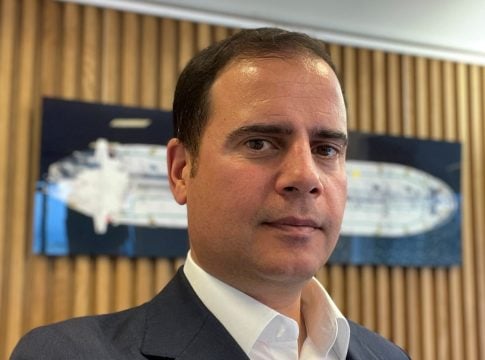

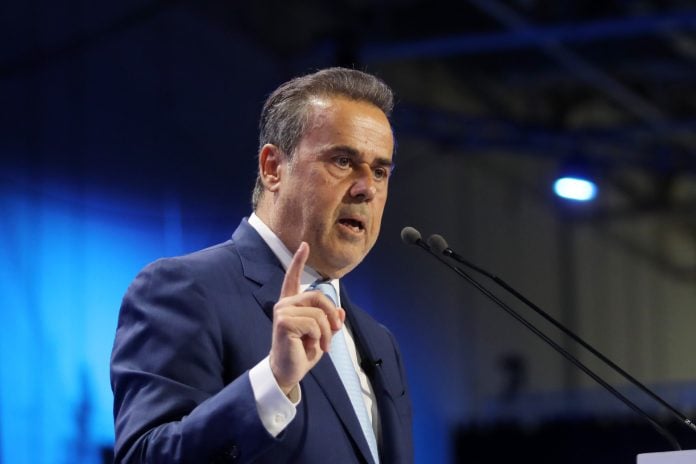
The role of Greece and Cyprus as a strategic hub in the new energy architecture of Europe and the East Mediterranean was highlighted by Environment and Energy Minister Stavros Papastavrou at the Global Energy Forum of the Atlantic Council.
Papastavrou linked energy security with national security, stressing the need for energy realism, technological neutrality, stronger infrastructure, and differentiation of the energy sources and supply routes.
“We learned it the hard way”
“We learned it the hard way,” Papastavrou said, referring to the challenges to energy security arising both from Russia’s invasion of Ukraine and from threats linked to the Strait of Hormuz.
He said these crises had exposed the “systemic risk of the weaponization of energy,” whether originating from Russia, Iran or any other country. Europe, he added, must remain united in confronting this phenomenon, as the weaponization of energy affects both regional and global security.

“We must remain technologically neutral”
“We must remain technologically neutral,” Papastavrou said, stressing that Europe needs energy and that “energy security is national security.” In this context, he argued that Europe should utilise all available domestic resources in order to strengthen its energy independence.
Carbon tax on global shipping
Papastavrou addressed the debate in Europe over the introduction of a carbon levy on global shipping. He noted that international shipping accounts for less than 3% of global emissions while carrying more than 90% of world trade.
“That is not a good starting point,” he said.
According to the minister, European policymakers now recognise that clean-energy targets did not sufficiently take into account economic competitiveness and social cohesion. He stressed that this does not represent a change in direction, but rather “a recalibration of the pace” of the transition.
He also noted that, compared with the 2022 energy crisis, when it took the European Union roughly 12-14 months to recognise the need for coordinated action, European responses are now much faster. The energy realism approach initially advanced by Prime Minister Mitsotakis, he said, has evolved into a “common-sense approach” embraced by the majority of European countries.
Για να εμφανίζονται περισσότερα άρθρα της Ναυτεμπορικής στις αναζητήσεις σας εύκολα και γρήγορα, πρέπει να προσθέσετε το site στις προτιμώμενες πηγές σας. Μπορείτε να το κάνετε πηγαίνοντας εδώ.