
The India–Middle East–Europe Corridor (IMEC) is emerging as a major initiative for the development of alternative freight and energy transport routes between Asia and Europe.
Amid rising geopolitical tensions along traditional maritime trade routes, Greek ports are seeking to secure a role in the emerging commercial architecture being shaped in the Eastern Mediterranean, aiming to establish themselves as key transshipment and logistics hubs for European and Balkan markets.
Statement by V. Kikilias
Speaking at the Mare MED III Conference Athens 2026, Minister of Maritime Affairs and Insular Policy Vassilis Kikilias described Greece as a “natural gateway” for the IMEC corridor into Europe, stressing that Athens is actively supporting the initiative in cooperation with Israel, Cyprus, and the United States.
“Greece is a natural gateway for IMEC. This is a major strategic investment of enormous significance,” he said, adding that despite geopolitical tensions and ongoing instability in the Middle East, regional countries must continue to plan with a long-term strategic horizon.


An alternative to the Suez Canal
The IMEC was described as an ideal alternative to the pressures and geopolitical uncertainties affecting the Suez Canal by Pinhas Tsruya, CEO of Israel Ports Company (IPC).
He highlighted the need for alternative trade and energy corridors amid increasing geopolitical strain on traditional maritime routes. According to him, IMEC could evolve into a new strategic freight axis linking India, the Middle East, and Europe via Israel and Greece.
Tsruya revealed that IPC has already conducted detailed studies on potential cargo volumes, including scenarios of approximately 5 million TEUs annually as an alternative routing option to the Suez Canal.
In this context, he added that IPC is assessing the future capacity of Israeli ports as well as the investments required to support increased container and cargo throughput.
He noted that in recent years Israel has made significant investments in upgrading its port infrastructure, including the development of two new terminals in Haifa, which have increased capacity, competition, and service quality.
According to the company’s analysis, even with additional IMEC-related cargo volumes, Israeli ports have sufficient capacity through to 2042, provided that further development phases continue as planned.
He also placed strong emphasis on inland logistics, noting that due to limited available land around ports, Israel is developing an “inland ports” model—internal logistics hubs connected to ports via rail and road networks.
Three major inland ports are planned to operate as extensions of seaports, accelerating container flows to and from Haifa and other regions of the country.
Regional positioning and Greece’s role
Within this framework, the port of Thessaloniki is gaining strategic importance in the new trade architecture envisioned by IMEC, with Northern Greece positioning itself as a key transit gateway for flows towards the Balkans and Central Europe.
Piraeus – Thessaloniki
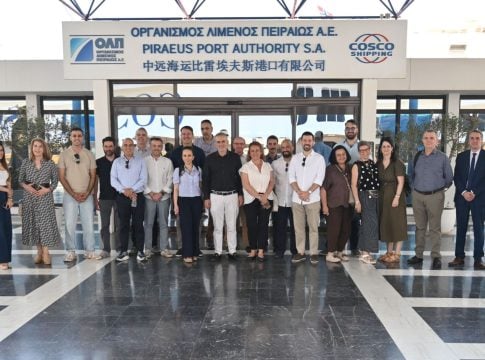
Both the port of Piraeus and the port of Thessaloniki are participating in the Mare MED III Conference Athens 2026.
It is widely expected that the port of Piraeus will seek to play an active role in serving both existing and emerging trade corridors between Asia, the Middle East, and Europe.
On his part, Nikolaos Fokas, Commercial Director of Thessaloniki Port Authority (OLTH), told Naftemporiki that Thessaloniki’s strategic location and its ability to connect directly with Israel in under 48 hours create new opportunities for trade and logistics flows in the Eastern Mediterranean.
He added that, through a unified logistics gateway, the port of Thessaloniki could serve markets of over 40 million consumers in the Balkans, stressing the need for further investment in rail connections, multimodal transport, and logistics infrastructure, with the expansion of Pier 6 being a critical project.
Fokas also highlighted prospects for cooperation between Thessaloniki and Israeli ports, noting that IMEC could generate new trade flows and a stronger transport network across the Eastern Mediterranean.
Για να εμφανίζονται περισσότερα άρθρα της Ναυτεμπορικής στις αναζητήσεις σας εύκολα και γρήγορα, πρέπει να προσθέσετε το site στις προτιμώμενες πηγές σας. Μπορείτε να το κάνετε πηγαίνοντας εδώ.