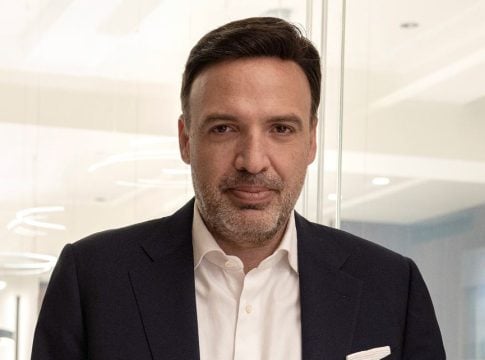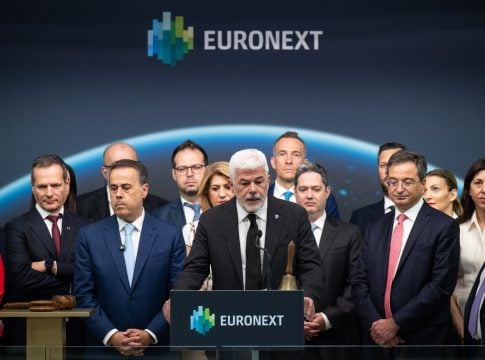

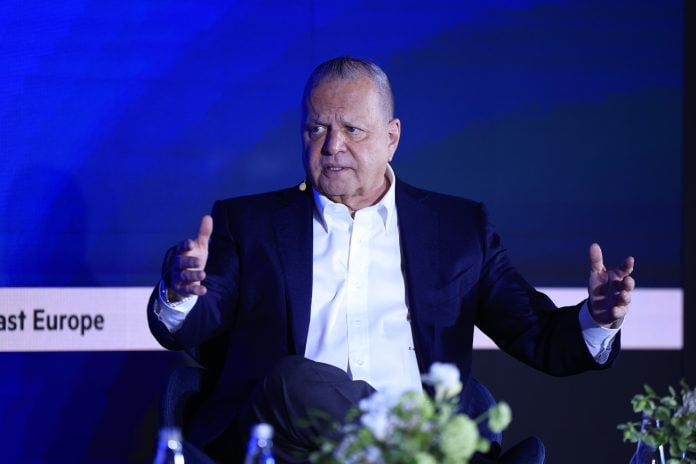
Developments in the Strait of Hormuz and their impact on global markets dominated the discussion between METLEN Executive Chairman Evangelos Mytilineos and Financial Times’ European Editor Ben Hall during the Energy Transition Summit taking place in Athens.
Referring to the commodities market, Mytilineos stressed that aluminium prices are recording a significant increase, as a large share of global production is concentrated in the Gulf region. At the same time, natural gas — which he described as the most critical raw material for his industry — has risen by 40–50%, substantially increasing production costs, although, as he noted, the company has already hedged its exposure for 2026 and 2027.
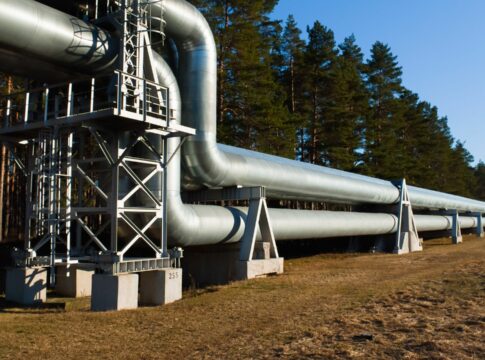
Mytilineos also pointed out that Europe risks replacing one dependency with another, shifting from Russian pipeline supplies to liquefied natural gas (LNG), mainly of US origin, which now accounts for approximately 80% of the company’s imports through the Revithoussa LNG Terminal facility. He further warned that the use of energy as a geopolitical instrument by the United States would have far broader implications for transatlantic relations.
The competitiveness of European industry
In the same context, he referred to the issue of the competitiveness of European industry, noting that for industries competing internationally with electricity prices of around 30 euros/MWh, survival becomes extremely difficult under current cost conditions. As he remarked, European industry has been trying for years to explain the problem to Brussels, without any meaningful response.
At the same time, he criticized the European Union’s approach towards heavy industry, noting that for years the prevailing perception was that Europe no longer needed energy-intensive industries. Regarding Europe’s energy outlook, he warned that lower natural gas storage levels compared with previous years are creating additional pressure, while a shift in demand towards Asia could send prices soaring. As he stressed, markets currently believe that tensions in the Gulf will be short-lived.


Renewable energy increase driven by need for energy security
Regarding the transition towards cleaner forms of energy, Mytilineos underlined that current priorities are shifting away from decarbonization and climate concerns towards energy security. As he noted, countries with limited access to cheap energy are accelerating investments in renewable energy sources and infrastructure in pursuit of greater autonomy, while Europe is also reassessing its strategy under the weight of geopolitical instability.
He placed particular emphasis on energy storage, stressing that the next major boost for renewable energy will stem less from climate concerns and more from the need for energy security. However, he pointed out that the key challenge remains storage capacity — especially covering overnight demand — since full independence from fossil fuels will not be feasible without affordable batteries capable of providing 6–10 hours of storage. “The problem we need to solve collectively as an energy community is what we do during the night,” he said.
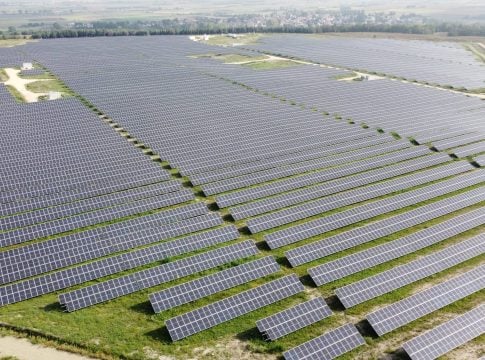
In this context, he referred to METLEN’s new large-scale 330 MW energy storage project, currently under construction and due to be delivered in the near future, noting that even one of Europe’s largest battery systems today can provide only around two hours of domestic energy coverage.
On electricity prices, he stated that their linkage to natural gas prices is creating a serious competitiveness problem for industry, as average power prices remain at very high levels.
Για να εμφανίζονται περισσότερα άρθρα της Ναυτεμπορικής στις αναζητήσεις σας εύκολα και γρήγορα, πρέπει να προσθέσετε το site στις προτιμώμενες πηγές σας. Μπορείτε να το κάνετε πηγαίνοντας εδώ.