
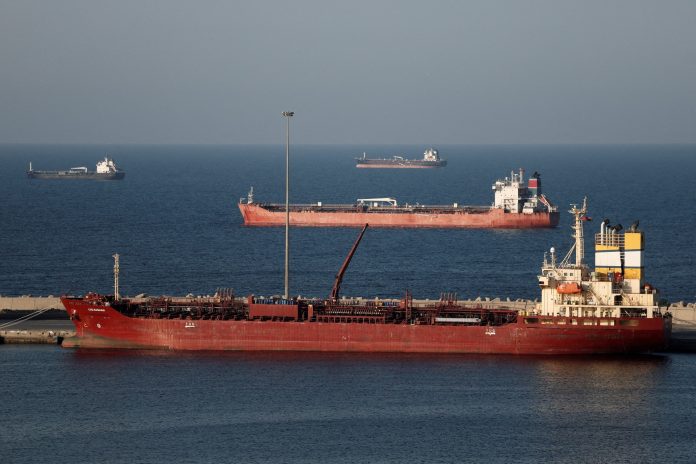
Navigation remains limited in the Strait of Hormuz following the dual blockade by the US and Iran, with transits recorded at exceptionally low levels on Wednesday.
According to available data from the security firm Diaplous, two cargo ships moved outbound in ballast (without cargo), one of which is Greek-owned. Simultaneously, a fully loaded tanker of Chinese interests transited inbound, utilizing the Iranian corridor controlled by the Revolutionary Guard. Of particular interest is the case of the tanker Rich Starry (MR), which, despite being under US sanctions, managed to cross the Strait after two attempts.
However, a few hours later it returned, having deactivated its AIS system. The vessel, formerly the Full Star, had the United Arab Emirates as its last port of call. As a consequence, the employment of Very Large Crude Carriers (VLCCs) has dropped to historically low levels. Despite the emergence of new trade flows from the United States to Asia, as well as the increased use of the Yanbu port in Saudi Arabia—a key energy hub in the Red Sea that facilitates oil exports by bypassing the Persian Gulf—the primary VLCC market in the Middle East remains effectively “frozen.”
Για να εμφανίζονται περισσότερα άρθρα της Ναυτεμπορικής στις αναζητήσεις σας εύκολα και γρήγορα, πρέπει να προσθέσετε το site στις προτιμώμενες πηγές σας. Μπορείτε να το κάνετε πηγαίνοντας εδώ.