

In the aftermath of the navigation blockade in the Strait of Hormuz (Operation Epic Fury), a parameter that passed unnoticed concerns the temporary suspensions of the US Jones Act for two and three months, respectively.
The US Merchant Marine Act of 1920 was sponsored by Senator Wesley Jones (R-Washington) following the end of World War I. It provides that cargoes between American ports will only be carried by US-flag ships that are US-built, 75% owned by US citizens, and manned by US seafarers (Article 27). This constitutes the US cabotage legislation for coastal shipping.
On March 17, 2026, the Department of Homeland Security issued a decision concerning a waiver of the Jones Act following a request from the Department of War. The decision covers 659 products (e.g., natural gas, crude oil, derivatives, fertilizers, and coal), allowing foreign-flag vessels to transport them between US ports until May 17, 2026. This action is expected to mitigate short-term disruption in the energy market to meet the demands of Operation Epic Fury. Upon its expiry on May 17, 2026, the waiver was extended for another 90 days until October 16, 2026, triggering a wave of criticism from various US quarters.
Several countries have adopted maritime cabotage legislation, but the US version is among the most restrictive. In the European Union, cabotage legislation was adopted by Regulation 3577/1992 concerning freedom to provide maritime transport services within member states, following epic battles between the member states that supported it (in the South, like Greece) and those that did not (in the North). The US, shattered by the loss of lives and the economic cost of WWI, attempted to redefine the notion of “America First” (1918). For more than two decades, they displayed unprecedented international isolationism.
What is the ratio legis purported to be covered by the Jones Act? Economic protection and national security. It concerns protection from competition for American shipyards, seafarers, and shipping companies. Foreign shipowners with foreign flags, lower-cost seafarers compared to Americans, and ships built in the Far East render American ships non-competitive. These arguments have both advantages and disadvantages. The US Government Accountability Office (GAO), the non-partisan congressional watchdog, has repeatedly investigated the positive and negative aspects of the law. It assesses that the economic cost of shipbuilding under the Jones Act is sensational. In any event, the 21st-century application of a law serving realities that prevailed at the beginning of the 20th century is untenable.


Regarding the national security argument, the existence of a national fleet keeps shipyards open and guarantees a minimum number of domestic ships for sealift purposes. Yet, sealift may be guaranteed by reliable commercial fleets of allied countries, as has been the case for decades with the Military Sealift Command. Moreover, the US fleet is dwindling despite the existence of the law. Out of 7,500 tankers worldwide, only 54 meet the requirements of the law, and they do so at an exorbitant cost. The conclusion is that US coastal shipping is strategically non-existent and structurally prohibitive.
Non-application of the law will allow ships under other flags, including Greek ships, to carry oil and other cargoes between American ports at a lower cost. Supporters of the law maintain that its abolition will undermine shipbuilding in the US and the employment of American seafarers. On the contrary, as was proven during its suspension, the liberalization of maritime transport through the abolition of the law will facilitate the operation of supply chains that are vital due to the war in Iran. Moreover, despite existing for one hundred years, the law did not succeed in creating a robust and internationally competitive commercial US shipping industry.
The International Chamber of Shipping (ICS) has多次 reiterated the disadvantages of the law to the US administration. This view is shared by the OECD (Organisation for Economic Co-operation and Development). According to an OECD study (2019), the abolition of the law would boost the American economy by 19 to 135 million USD. Moreover, the argument that the law is necessary to face Chinese competition is untenable. On the contrary, the existence of the law facilitates China and harms the US, according to the Cato Institute. In the US, the law has steady supporters and opponents. It is often on the agenda of Congress, in sessions where its pros and cons are rehearsed. This is something I have had the opportunity to witness during my professional visits to Congress over decades.
Shipbuilding according to the law costs four times more in the US compared to South Korea. These costs affect American consumers by doubling the prices of foodstuffs, diesel, fertilizers, and transportation, particularly to states and territories like Hawaii, Alaska, and Puerto Rico. In order to circumvent the law, oil distilled in Texas and Louisiana is carried by non-US ships to the Bahamas (outside the US) before reaching its final destination in California. This deviation adds time and miles to the journey but remains more efficient compared to the strict application of the law.
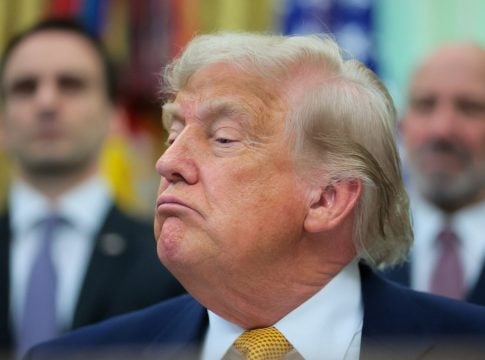
Supporters of the law insist that it is necessary for national security reasons. It is ironic that President Trump suspended its operation twice during Operation Epic Fury. It is a law about national security that is harming national security, as was most ingeniously noted by Colin Grabow, director of the Cato Institute! It is an oxymoron that a law supposedly indispensable for national security is suspended whenever there is a national security crisis or a national emergency.
Before President Trump, other US Presidents had suspended the application of the law: President Franklin Delano Roosevelt suspended it one week after Pearl Harbor (December 1941). President Barack Obama withdrew a decision for its abolition (2011). President Joe Biden suspended the law for oil transportation to the Eastern coast after a cyberattack closed a major pipeline (2021) and repeated the move in 2022 after Hurricane Fiona in Puerto Rico. Senator John McCain (R-Arizona) submitted draft laws and amendments for its abolition (2015, 2016). Characteristically, he stated: “The law may have had a reason when it was adopted, but now it is only used to increase costs. It renders American farmers and businessmen less competitive internationally and raises costs for consumers. It is an obstacle to worldwide free trade and invites other countries to do likewise and set their own obstacles.” The argumentation of this statement could have been written in Greece in support of Greek shipping, which thrives in open markets and free competition! Senator Mike Lee (R-Utah) submitted two relevant drafts in 2024. President Trump had also suspended its application after Hurricane Maria in Puerto Rico (2017).
In summing up, short-term suspensions are welcome, but they must lead to the final abolition of the law. Over the years, the law has failed to justify the reasons for its adoption. Since its suspensions take place during emergency periods, what is the reason for maintaining it in peacetime? President Trump suspended it for 60 days and 90 days to counter the higher energy prices caused by the war in Iran. This action will allow the free movement of oil, natural gas, fertilizers, and coal in US ports. The suspension should continue sine die, as requested by the American press. The existence of a century-old law that requires suspension every now and then underscores the need for its final abolition. The time has come to delete this costly, protectionist, counterproductive, and archaic law. The legislation that terminates the Jones Act is ready. It is high time it were adopted and applied!
* Senior consultant on European / international maritime policies
Για να εμφανίζονται περισσότερα άρθρα της Ναυτεμπορικής στις αναζητήσεις σας εύκολα και γρήγορα, πρέπει να προσθέσετε το site στις προτιμώμενες πηγές σας. Μπορείτε να το κάνετε πηγαίνοντας εδώ.