
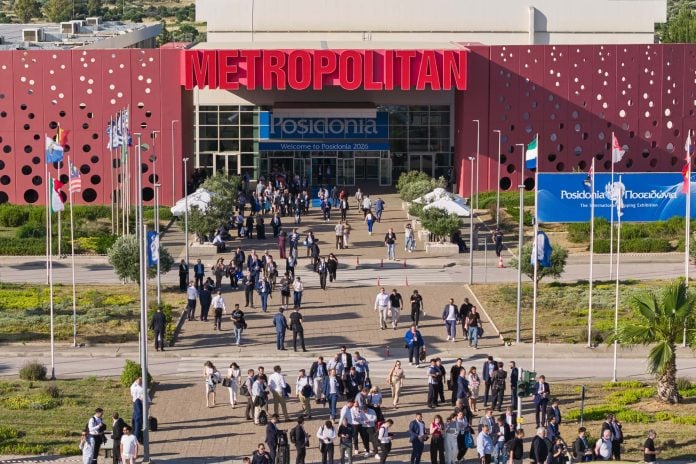
Posidonia 2026 concluded with record-breaking participation and visitor numbers, once again reaffirming its position as the world’s leading international platform for maritime business transactions and strategic dialogue within the shipping industry.
The 29th edition of the exhibition closed its doors on Friday at the Athens Metropolitan Expo, attracting more than 35,000 visitors and 2,200 exhibitors during a week in which the shipping industry—responsible for transporting approximately 87% of global trade—found itself at the centre of critical geopolitical, energy and regulatory developments. This year’s event took place against an exceptionally challenging international backdrop.
Disruptions in the Red Sea and the Strait of Hormuz, the rise of trade protectionism, and increasing pressure arising from the International Maritime Organization’s (IMO) decarbonisation targets for 2030 and 2050 contributed to an environment of heightened uncertainty.
Against this backdrop, Posidonia served not only as a venue for commercial networking and business agreements, but also as a focal point for an industry seeking direction, stability and broader consensus on its future course. Particular significance was attached to the fact that Posidonia 2026 was the first edition to take place following the implementation of the European Union’s Emissions Trading System (EU ETS) for maritime transport.
This new regulatory framework has fundamentally altered the economic landscape for both European-flagged fleets and international shipping operators calling at European ports.


As a result, the transition towards zero-emission shipping dominated the agenda throughout the five-day event, with discussions on fuels, technologies, infrastructure and regulatory frameworks taking centre stage.
At the same time, this year’s exhibition highlighted more clearly than ever that shipping now stands at the intersection of global trade, security and economic sovereignty.
With seafarers facing growing security threats, supply chains under increasing strain, and major trade routes becoming focal points of geopolitical tensions, Posidonia also served as a forum for strategic reassessment by the international maritime community.
Meanwhile, the strength of Greek shipowners and the capabilities of Greece’s shipbuilding and maritime industrial sector were clearly demonstrated through a series of significant business developments, new partnerships and announcements made during the week.
Greek shipowners once again confirmed their status as key players in global shipping markets, while interest in Greece as a hub for shipbuilding, logistics and energy connectivity remained particularly strong.
The Chief Executive Officer of Posidonia Exhibitions S.A., Theodore Vokos, noted that, as in every previous edition, Posidonia once again served as the stage for some of the shipping industry’s most significant commercial announcements, ranging from new vessel orders and technological partnerships to classification agreements and initiatives involving alternative fuels.
A distinctive feature of this year’s event was the strong presence of governmental and intergovernmental officials, further underscoring the extent to which shipping is increasingly viewed as a strategic issue closely linked to foreign policy, the energy transition and economic sovereignty.
Για να εμφανίζονται περισσότερα άρθρα της Ναυτεμπορικής στις αναζητήσεις σας εύκολα και γρήγορα, πρέπει να προσθέσετε το site στις προτιμώμενες πηγές σας. Μπορείτε να το κάνετε πηγαίνοντας εδώ.