

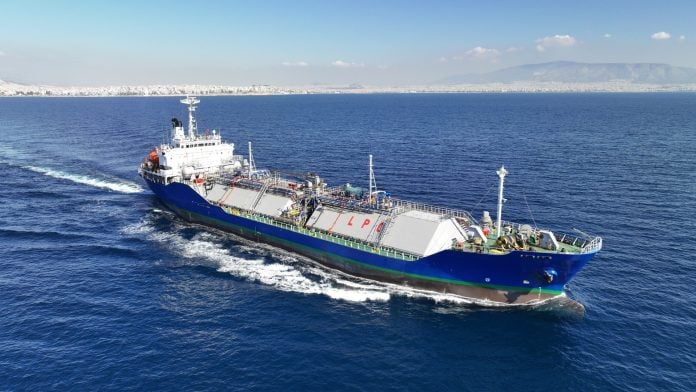
The LPG carrier market got off to a weak start this summer as freight rates began to retreat – particularly on routes to Asia – despite US LPG exports reaching a decade-high in May.
Rising transportation costs have started to erode arbitrage opportunities between regional markets, reducing the attractiveness of some cargoes and weighing on freight demand.
The main reason is the disruption caused by the Strait of Hormuz crisis, which has already affected global LPG trade patterns. Asia, traditionally heavily dependent on supplies from the Middle East Gulf (MEG), has moved rapidly to diversify its sourcing.
In 2025, around 46% of Asia’s LPG imports originated from the MEG, compared with 39% from the United States. This year, however, the balance has shifted markedly, with 51% of LPG cargo arrivals in Asia since the beginning of the year originating from the US.
US Exports Reach Decade High
May provided the clearest illustration of this trend. US LPG exports climbed to 2.91 million barrels per day, the highest level recorded in the past decade, with 59% of cargo destined for Asian markets.


The figure is 26% above the average level of US LPG shipments recorded across 2024 and 2025.
China remained the largest buyer of US LPG, accounting for 14.9% of American exports between March and May. Japan followed with a 12.4% share, while India ranked third at 9%.
The most notable shift, however, has been in India. Faced with constrained supplies from traditional sources, Indian importers turned aggressively to the US market, with the share of US-origin cargoes surging to 41% since the onset of the crisis. By comparison, the corresponding figure for 2025 stood at just 6%.
Supply Constraints Persist
Despite the sharp increase in US imports, neither India nor China has fully offset supply shortfalls.
India’s total LPG imports have fallen to 567,000 barrels per day since the crisis began, roughly 28% below the 2025 average of 785,000 barrels per day.
Similarly, China’s LPG imports have declined to 778,000 barrels per day, compared with an average of 1.2 million barrels per day during 2025.
The figures suggest that while US exports have helped fill part of the supply gap, the overall LPG market remains tight.
Freight Rates Surge Before Correcting
The supply squeeze quickly spilled over into the shipping market. Freight rates for LPG carriers surged as Asian buyers competed for US cargoes while vessel availability tightened.
However, the rally has recently begun to lose momentum, as elevated freight costs have narrowed arbitrage margins and reduced the commercial appeal of some long-haul shipments to Asia, prompting a correction in freight rates after their sharp rise.
Για να εμφανίζονται περισσότερα άρθρα της Ναυτεμπορικής στις αναζητήσεις σας εύκολα και γρήγορα, πρέπει να προσθέσετε το site στις προτιμώμενες πηγές σας. Μπορείτε να το κάνετε πηγαίνοντας εδώ.