
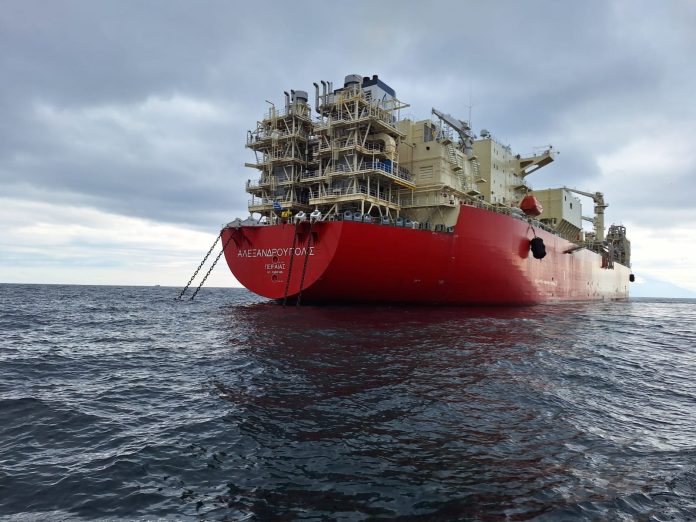
US “aid” includes, among other things, the best-case scenario that will allow the operation of Greece’s second FSRU next to the existing one off the coast of Alexandroupolis and which is operated by the company Gastrade (Copelouzos Group).
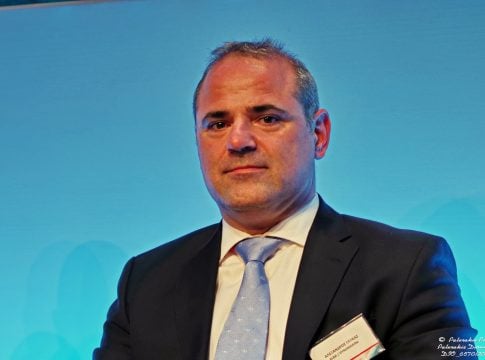
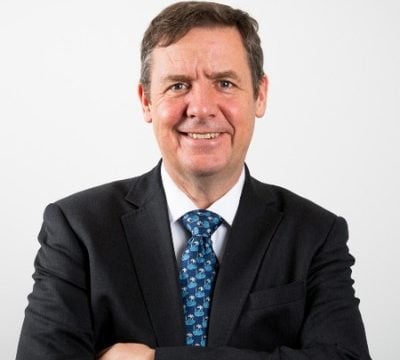
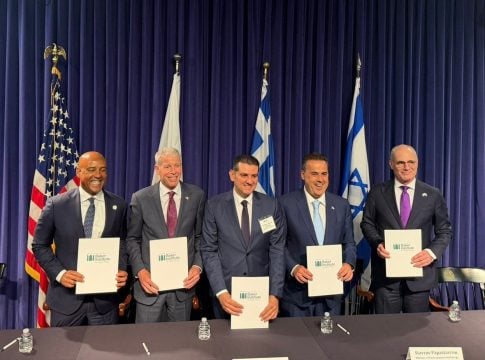
The company is in discussions with DFC (Development Finance Corporation) and EXIM (Export-Import Bank of the United States) in order to “support” the project of the FSRU in Greek waters and the third national gateway for liquefied natural gas, according to the CEO of Gastrade, Kostis Sifnaios.
The US interest, given the nature of the counterparties, concerns the prospect of a loan to finance the project or alternatively their participation in the shareholding structure of the project.
It is recalled, as “N” has written in a previous report, that the budget of the project called “FSRU Thrace” is estimated at around 550-600 million euros and comes to serve the export orientation of the Greek natural gas transportation system as a starting point for the “Vertical Corridor”.
The abolition of Russian gas is now being discussed, a fact that is expected to create a “gap” in the wider region of Southeastern Europe totaling 35 bcm, with more “moderate” estimates speaking of a total of 25 billion cubic meters (bcm), adding up both the “lack” of Russian gas and the organic development of markets in the region.


In this light, the company’s current design is “aligned” with the emerging energy reality and wants such infrastructures ready as soon as Russian gas is cut off, thus giving a corresponding positive sign to their sustainability. In this direction, the company is seeking financing, while American interest is highly on the agenda, recognizing at the same time the criticality of having “visibility” over time that will justify the project and which will result from the conclusion of long-term contracts.
30 billion over 15 years
In other words, as the CEO of Gastrade underlined, the development of a contract portfolio of around 50-60 cargoes per year in combination with the operating FSRU on the basis of 15-year agreements constitutes a favorable ground for making the final investment decision. Such an amount translates into 2 billion dollars per year, 30 billion over 15 years, figures that make the investment for a second FSRU in Alexandroupolis viable.
The latter, and if the “feasibility” of the project is successful, is expected to be obtained in 2026, or the first quarter of 2027, so that the project can be ready in 2028, when it will be necessary to replace the Russian gas flows that will have been terminated since the fall of 2027.
However, the company is even “looking forward” to European financing, although for the time being the scenario excludes “by law” the allocation of resources to conventional fuel projects.
Sifnaios emphasized that there is significant pressure on the Commission to partially “revise” the “green” principles in the context of supporting the project of phasing out reliance on Russian gas, which is objectively expected to radically change the data on the energy map of Europe.
Για να εμφανίζονται περισσότερα άρθρα της Ναυτεμπορικής στις αναζητήσεις σας εύκολα και γρήγορα, πρέπει να προσθέσετε το site στις προτιμώμενες πηγές σας. Μπορείτε να το κάνετε πηγαίνοντας εδώ.