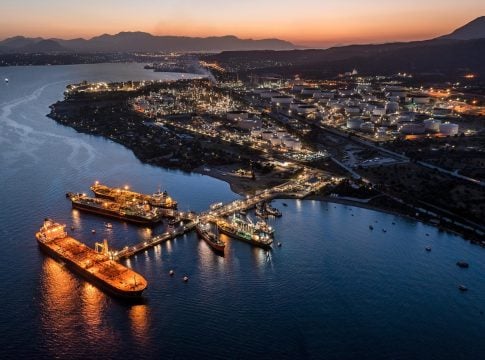

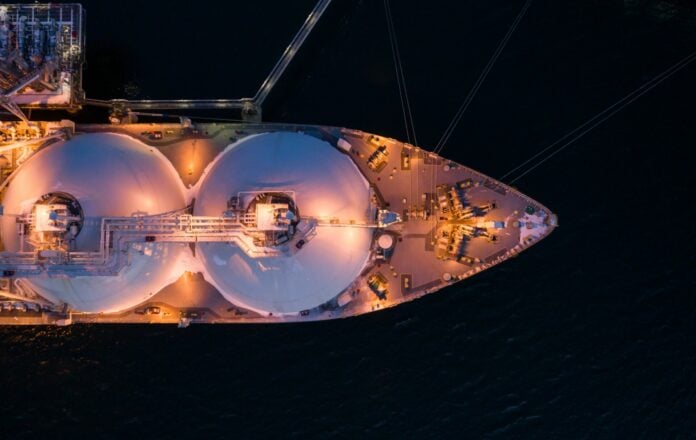
The United States has achieved a new energy milestone: It became the first country in the world to export 10 million tons of liquefied natural gas (LNG) in a single month.
According to British platform LSEG, US LNG exports reached 10.1 million tons in October, up from 9.1 million in September.
This performance, which solidifies the US’s global leadership in the LNG market, is driven by the start-up of Venture Global’s LNG plant in Plaquemines, Louisiana, and the expansion of Cheniere’s facilities in Corpus Christi, Houston.
Venture Global exported 2.2 million tonnes from its Louisiana facility, while Cheniere accounted for 4.2 million tonnes, or 42% of the national total.
Together, Venture Global and Cheniere accounted for 72% of U.S. exports in October. By 2026, Cheniere expects to exceed 50 million tons per year thanks to the expansion of its Corpus Christi facility.


Europe, a key market
Europe remains the main market for U.S. LNG, with 6.9 million tons (69% of the total). This is followed by Asia (1.96 million tons), Latin America (0.57) and Egypt (0.43). “The United States is thus consolidating its role as a key global LNG supplier, especially for European energy needs,” market representatives stated to Naftemporiki.
EU natural gas consumption fell by more than 20% between 2021 and 2024. While it increased by 4% in the first half of 2025 compared to the previous year, it remained 21% lower than the 2021 level. IEEFA predicts that EU LNG imports will fall by 19% to 110 billion cubic meters between 2025 and 2030.
However, dependence on US natural gas is growing. In the first half of 2025, 57% of European LNG imports came from the US.
The EU between diversification and new dependence
With the REPowerEU initiative, the European Union aims to end its dependence on Russian fossil fuels by 2027. The ban on Russian LNG is scheduled to come into force around the same time.
With the agreement signed by Commission President Ursula von der Leyen with President Trump last July, the EU committed to buying US energy worth 250 billion dollars per year over the next three years – a total of 750 billion dollars.
But this is where the criticism comes from the Australian Institute for Energy Economics and Financial Analysis (IEEFA), which promotes the transition to cleaner energy. “If Europe replaces Russian gas with American LNG, it is simply exchanging one dependency for another,” IEEFA said. In Central and Eastern Europe, LNG imports covered only 11% of the 181 billion cubic meters of natural gas demand in 2024.
Domestic production amounted to 41 billion cubic meters, mainly from Ukraine, Romania, Poland, Germany and Hungary. Pipeline gas came from Azerbaijan, Norway, Russia and Turkey.
Even after the Russian pipeline through Ukraine ended on January 1, 2025, gas continued to flow to demand points. The region has diversified its supply sources – but the growing focus on US LNG could again put that diversity at risk, IEEFA estimated.
Greece and the Trans-Balkan Pipeline
Greece has tripled its natural gas imports since 2020 and is supporting shipments through the once under-utilized “Trans-Balkan Pipeline.” Network operators from Greece, Bulgaria, Romania, Moldova and Ukraine have called on their regulators to approve an increase in transmission capacity by April 2026.
“Greece is putting an end to a Russian-dominated energy supply system. Today, Greece becomes a starting point, an entry point for US energy trade in Europe,” US Energy Secretary Chris Wright told Reuters, speaking at the recent energy conference held in Athens.
Ukraine and Romania have expressed interest in purchasing up to 3.7 billion cubic meters from the Greek consortium between 2030 and 2050.
In any case, the gradual elimination of Russian gas from the EU by 2027 constitutes a significant opportunity to reshape the energy map of Southeastern Europe.
Για να εμφανίζονται περισσότερα άρθρα της Ναυτεμπορικής στις αναζητήσεις σας εύκολα και γρήγορα, πρέπει να προσθέσετε το site στις προτιμώμενες πηγές σας. Μπορείτε να το κάνετε πηγαίνοντας εδώ.